Kilograms and pounds: the complete conversion guide
Last updated: 9 November 2026.
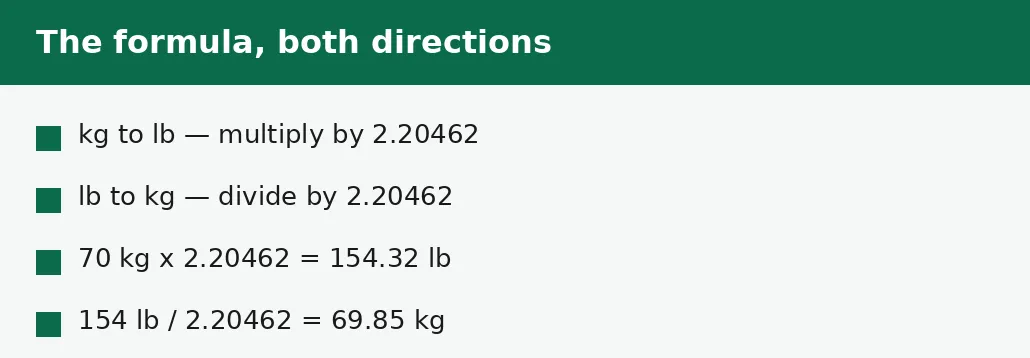
One kilogram is exactly 2.20462 pounds, and one pound is 0.453592 kilograms. To convert kilograms to pounds, multiply by 2.20462 — 70 kilograms is 70 times 2.20462, which is 154.32 pounds. To convert pounds to kilograms, divide by 2.20462, or multiply by 0.453592 — 154 pounds is 154 times 0.453592, which is 69.85 kilograms. The factor is exact by definition: the pound is defined as 0.45359237 kilograms, so the conversion never drifts and never needs updating.
The definition: why the factor is exact
The kilogram is the world's base unit of mass, defined by a fixed constant of nature since 2019. The pound is defined in terms of it: one avoirdupois pound is exactly 0.45359237 kilograms, by international agreement since 1959. That definition makes the conversion factor exact, not measured — 1 kilogram is 1 divided by 0.45359237 pounds, which is 2.2046226218 pounds, usually rounded to 2.20462.
Exact matters because it means the conversion never changes: there is no new measurement to wait for, no standard to update, no drift between sources. Any two converters that disagree about kilograms and pounds disagree because one of them rounded differently, not because the factor is uncertain. The miles and kilometres guide covers a conversion with the same kind of exact definition; the Celsius and Fahrenheit guide covers one where the relationship is a formula rather than a single factor.
How to convert kilograms to pounds
Multiply the kilograms by 2.20462. Seventy kilograms is 70 times 2.20462, which is 154.3234, rounded to 154.32 pounds. For a rough answer in your head, double the kilograms and add a tenth: 70 doubled is 140, a tenth of 70 is 7, and 140 plus 7 is 147 — close to the true 154, but short by about 5 percent, because doubling and adding a tenth multiplies by 2.1 rather than 2.20462. The honest mental shortcut is to multiply by 2.2: 70 times 2.2 is 154, which is within a fraction of a pound of the exact answer.
To go the other way — pounds to kilograms — divide by 2.20462, or multiply by 0.453592. A weight of 154 pounds is 154 divided by 2.20462, which is 69.85 kilograms. In your head, halve the pounds and add a tenth of the result back: half of 154 is 77, a tenth of 77 is 7.7, and 77 minus 7.7 is 69.3 — again close, again slightly short, and good enough when a scale is not at hand.
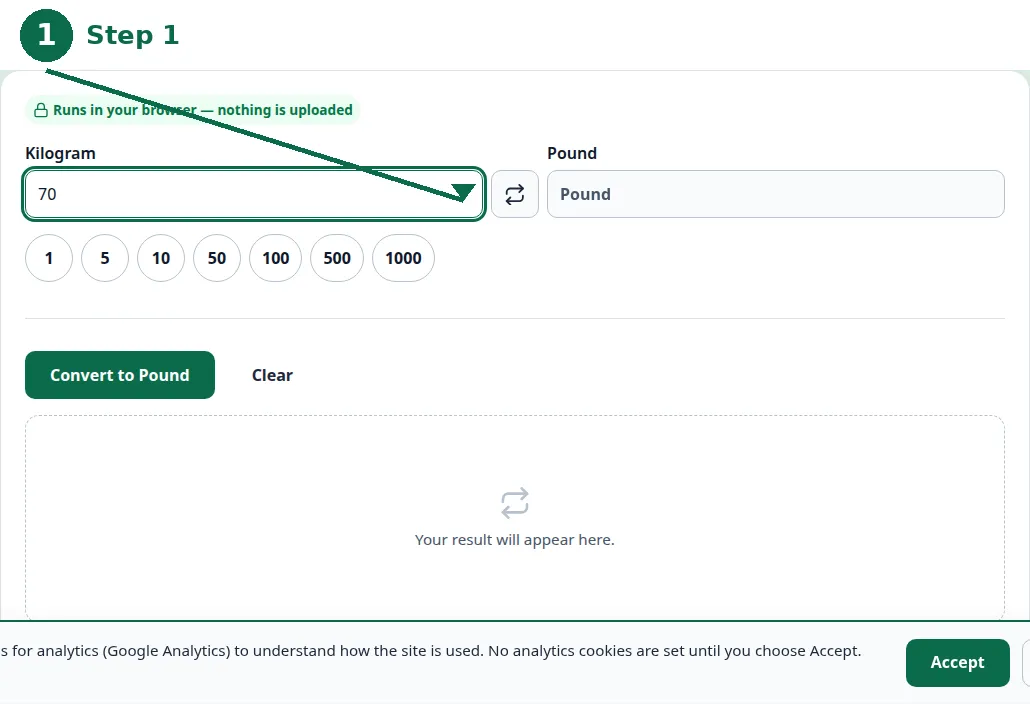
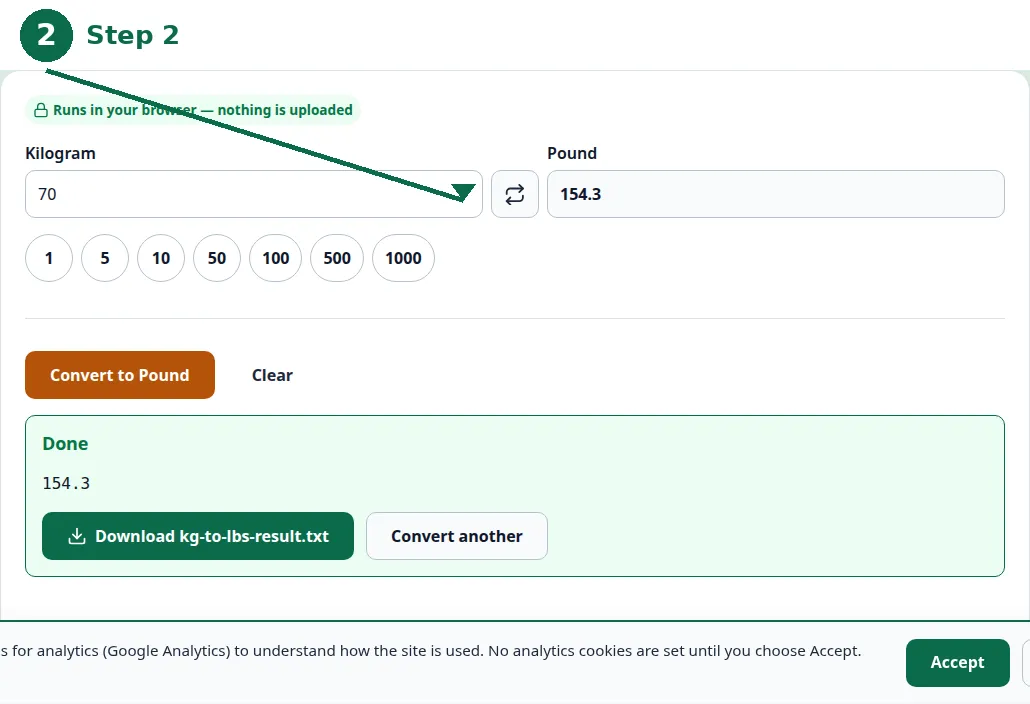
- Step 1 — Open the Kilograms to Pounds tool and enter the weight in kilograms.
- Step 2 — Click Convert and read the result in pounds.
- Step 3 — Check the rounding: two decimal places for body weight, one for luggage, whole pounds for a rough answer.
- Step 4 — To convert back, divide the pounds by 2.20462 — or use the same tool in reverse.
The formula, both directions
Pounds equal kilograms times 2.20462. Kilograms equal pounds divided by 2.20462, which is the same as pounds times 0.453592. There is nothing else to the conversion: no offset, no temperature correction, no second factor. It is a single multiplication in one direction and a single division in the other, which is why it is one of the easiest conversions to check — multiply the answer back and you should land on the number you started with.
Stones are the third unit in this family, used for body weight in the United Kingdom and Ireland: one stone is 14 pounds, which is 6.35029 kilograms. A weight of 11 stone is 154 pounds, which is 69.85 kilograms. The BMI calculator takes weight in kilograms, so converting stones to kilograms first is the usual route for anyone tracking their BMI in stones.
Conversion table: kilograms to pounds
The weights people actually convert are body weights, luggage weights and food weights, and they cluster in a narrow range. The table below covers the common ones, worked to two decimal places — the precision that matters for a scale, a suitcase and a recipe.
For values outside the table, the formula is the tool: multiply by 2.20462 and round to the precision the job needs. A recipe needs one decimal place at most; a body weight needs two; a luggage allowance needs the airline's own rounding, which is usually down to the nearest whole kilogram.
| Kilograms | Pounds | Used for |
|---|---|---|
| 1 kg | 2.2 lb | A bag of sugar. |
| 5 kg | 11.02 lb | A small bag of flour. |
| 7 kg | 15.43 lb | A cabin bag allowance. |
| 10 kg | 22.05 lb | A small suitcase. |
| 20 kg | 44.09 lb | A checked bag, light. |
| 23 kg | 50.71 lb | A checked bag, standard. |
| 50 kg | 110.23 lb | A light adult. |
| 70 kg | 154.32 lb | An average adult. |
| 90 kg | 198.42 lb | A heavy adult. |
| 100 kg | 220.46 lb | A round number for scale. |
Everyday uses: weight, luggage and recipes
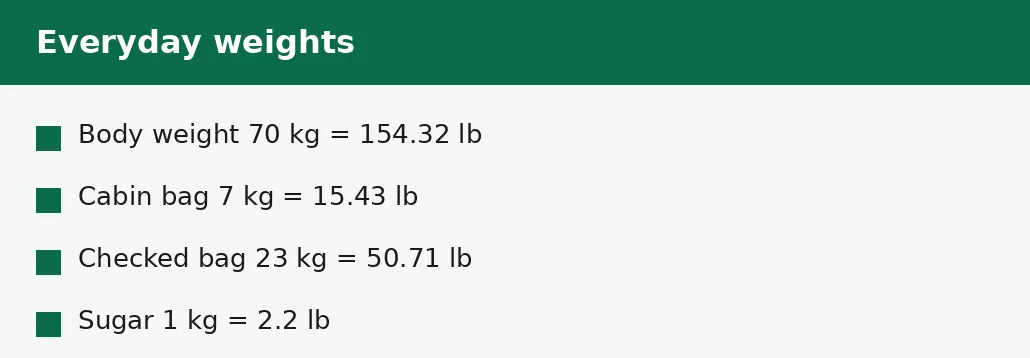
Body weight is the most common conversion, and the one where the direction matters most: scales in the United States read in pounds, scales almost everywhere else read in kilograms, and a person tracking their weight across both needs the conversion every time. Seventy kilograms is 154.32 pounds; 154 pounds is 69.85 kilograms. The two numbers describe the same body, and the difference between them is only the unit.
Luggage is the conversion with consequences: an airline that allows 23 kilograms allows 50.71 pounds, and a bag that weighs 24 kilograms is over the limit by a kilogram, not by a rounding error. Check the airline's own limit in kilograms before you convert — the conversion is exact, so if the bag is over, it is over, and the fix is to remove a kilogram, not to find a friendlier converter. Recipes are the gentlest use: a kilogram of flour is 2.2 pounds, and a recipe that calls for 500 grams needs 1.1 pounds, which is close enough to a pound that most cooks round it without a second thought.
The mistakes to avoid
The most common mistake is converting the wrong way: dividing when you should multiply, and ending up with 70 kilograms as 31.75 pounds — a number that should look obviously wrong, since a kilogram is more than two pounds, so the pounds number must always be bigger than the kilograms number. If the pounds came out smaller, the direction is reversed.
The second mistake is confusing pounds with stones: 11 stone is 154 pounds, not 11 pounds, and entering 11 where 154 belongs gives a weight of 4.99 kilograms — a small child, not an adult. And the third mistake is trusting a rounded factor for a precise job: 2.2 is fine for a recipe, but a laboratory or a shipping calculation wants 2.20462, because the rounding error grows with the weight.
More unit guides
Weight is one of several unit families on this site, and each has its own complete guide. The litres and gallons guide covers volume for fuel, cooking and tanks. The inches and centimetres guide covers small lengths — screens, heights, paper. The miles and kilometres guide covers distance for driving and running. And the Celsius and Fahrenheit guide covers temperature. All of them use the same pattern: an exact factor or formula, a table of the common values, and the everyday uses.
Troubleshooting
Why is my pounds number smaller than my kilograms number?
The conversion is backwards. A kilogram is 2.20462 pounds, so the pounds number must always be bigger. Multiply kilograms by 2.20462 — do not divide.
Why do two converters give slightly different answers?
They rounded the factor differently: 2.2, 2.2046 and 2.20462 all give slightly different results. The exact factor is 2.20462 — and for a precise job, use the full 2.2046226218.
Why is my luggage overweight after converting?
The conversion is exact, so the bag really is over the limit. A 24-kilogram bag is over a 23-kilogram allowance by a full kilogram. Remove a kilogram rather than looking for a friendlier converter.
Common questions
How many pounds is 1 kilogram?
Exactly 2.20462 pounds. The pound is defined as 0.45359237 kilograms, so the factor is exact by definition, not approximate.
How do I convert kilograms to pounds?
Multiply the kilograms by 2.20462. 70 kilograms is 70 times 2.20462, which is 154.32 pounds.
How do I convert pounds to kilograms?
Divide the pounds by 2.20462, or multiply by 0.453592. 154 pounds is 154 divided by 2.20462, which is 69.85 kilograms.
How many kilograms is 11 stone?
69.85 kilograms. One stone is 14 pounds, so 11 stone is 154 pounds, and 154 pounds is 69.85 kilograms.
Is 2.2 a good enough conversion factor?
For recipes and rough answers, yes — 70 kilograms times 2.2 is 154, within a fraction of a pound of the exact 154.32. For luggage, shipping or science, use 2.20462.
Why is the factor exact?
Because the pound is defined in kilograms: one pound is exactly 0.45359237 kilograms by international agreement. The conversion factor is a definition, not a measurement.
Summary
One kilogram is exactly 2.20462 pounds; multiply kilograms by 2.20462 to get pounds, divide to go back. Seventy kilograms is 154.32 pounds, and the pounds number must always be bigger than the kilograms number. The factor is exact by definition, so any disagreement between converters is a rounding difference, not a real one.