Miles and kilometres: the complete conversion guide
Last updated: 8 November 2026.
One mile is exactly 1.60934 kilometres, because one mile is defined as exactly 1609.34 metres. To convert miles to kilometres, multiply the miles by 1.60934; to convert kilometres to miles, divide the kilometres by 1.60934 — or multiply by 0.621371, which is the same thing written the other way. A marathon is 42.195 kilometres — 26 miles 385 yards, commonly rounded to 26.2 miles — a 100-mile road trip is 160.934 kilometres, and a 10-kilometre run is 6.21371 miles. The factor is exact, so the only errors in a conversion come from rounding, not from the number itself.
The definition: why the factor is exact
One mile is defined as exactly 1609.34 metres — not approximately, but exactly, by international agreement — and one kilometre is exactly 1000 metres. So one mile is exactly 1.60934 kilometres, and the factor carries no uncertainty at all: it is a definition, not a measurement. That matters, because it means every miles-to-kilometres conversion is exact, and the only errors come from rounding the result, never from the factor.
The mile's history is longer than its definition: it comes from the Roman mille passus, a thousand paces, and it survived in Britain and the United States while most of the world adopted the kilometre. Today the two systems meet constantly — road signs, race distances, route planners, travel — and the conversion between them is one of the most used on this site, which is why it has a guide of its own and a converter that keeps full precision rather than rounding.
The formula, both directions
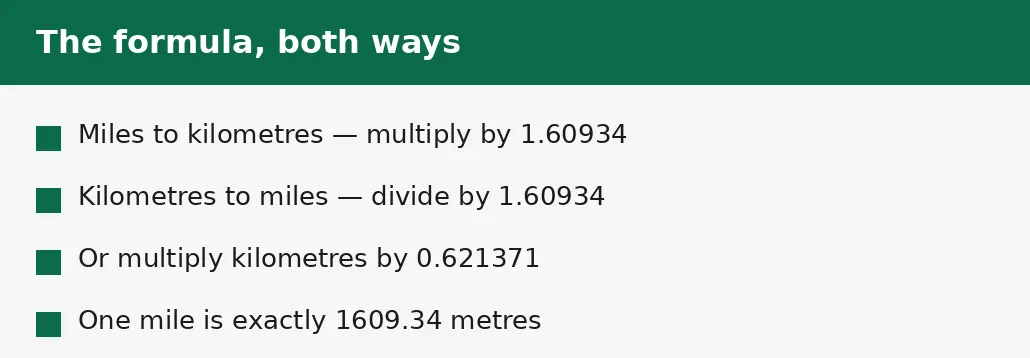
Miles to kilometres: multiply the miles by 1.60934. Kilometres to miles: divide the kilometres by 1.60934, or multiply by 0.621371 — the reciprocal of 1.60934, which is the same operation written the other way. Both directions use the same exact factor, so converting there and back returns the original number, apart from rounding.
A worked example, step by step: a marathon is 42.195 kilometres, which is 26 miles 385 yards — 26.219 miles. Multiply 26.219 by 1.60934: 26 times 1.60934 is 41.843, and 0.219 times 1.60934 is 0.352, so the total is 42.195 kilometres, the official marathon distance. The other direction: 10 kilometres divided by 1.60934 is 6.21371 miles, so a 10-kilometre run is a 6.21-mile run.
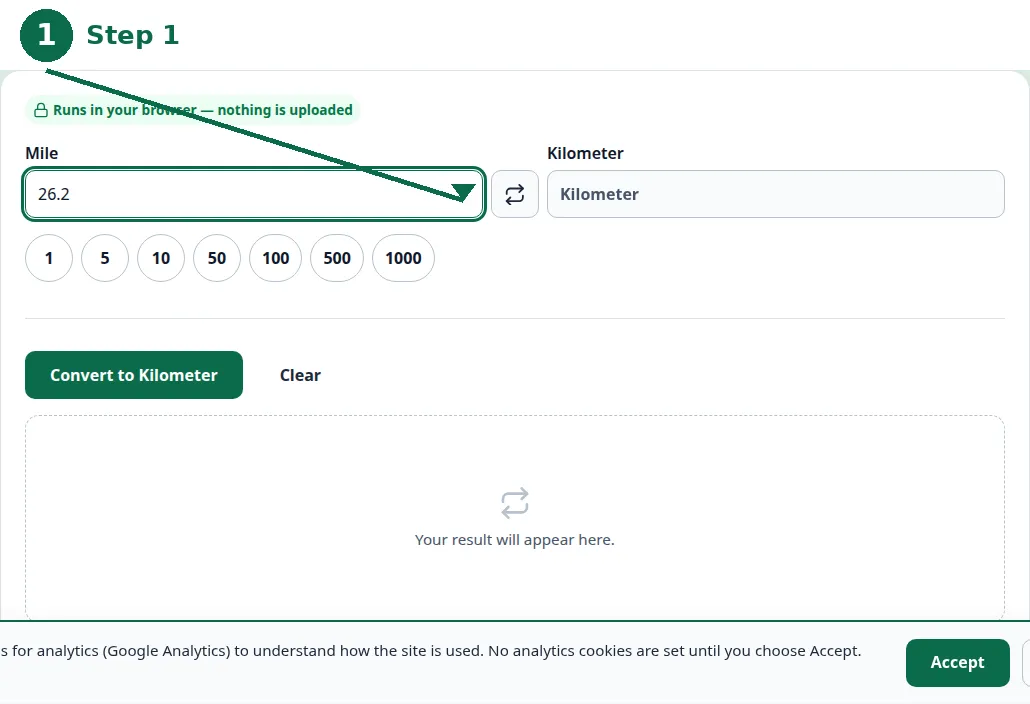
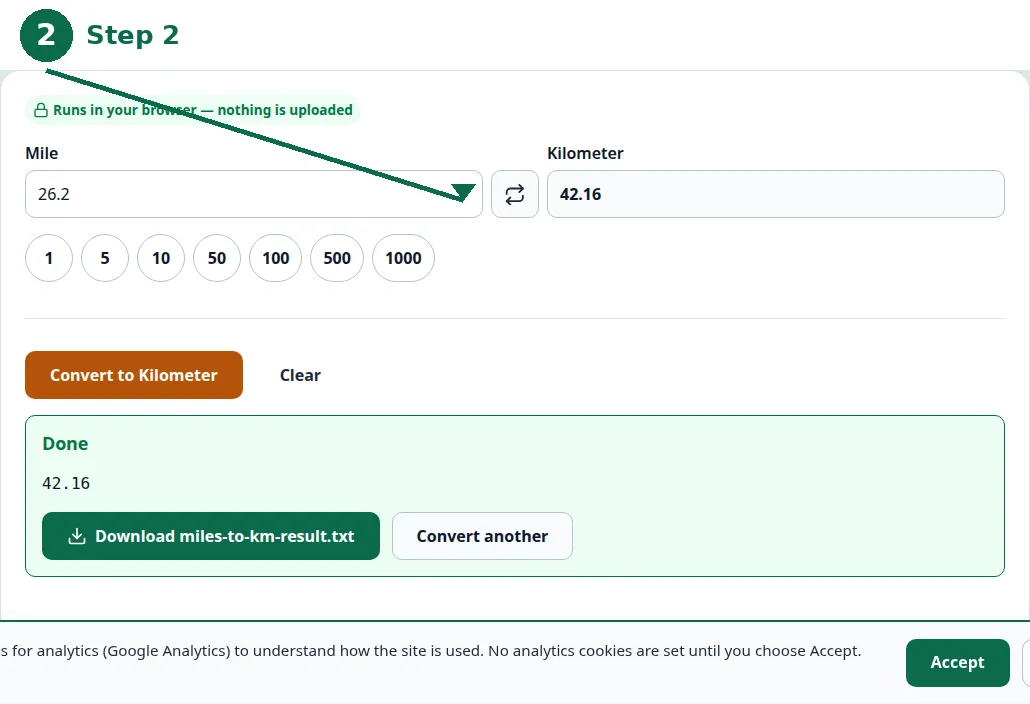
- Step 1 — Open the Miles to Kilometres converter and enter the miles.
- Step 2 — Click Convert and read the kilometres.
- Step 3 — For the other direction, use the Kilometres to Miles converter, or divide by 1.60934.
- Step 4 — Round the result to the precision the job needs — two decimals for a race, none for a road trip.
Conversion table: miles to kilometres
The table below gives the common distances in both directions, worked at full precision and rounded to five decimals where the exact figure needs them. Race distances and road trips are the ones people look up most: a 5-kilometre run, a 10-kilometre run, a half marathon, a marathon, and the round hundreds of a road trip.
For distances beyond the table, the formula is the table: multiply by 1.60934, or use the converter, which keeps full precision rather than rounding. The converter is the better tool for an unusual number, because it does not round the factor — it multiplies by the exact 1.60934 every time.
| Miles | Kilometres | Kilometres | Miles |
|---|---|---|---|
| 1 | 1.60934 | 1 | 0.62137 |
| 5 | 8.04672 | 5 | 3.10686 |
| 10 | 16.0934 | 10 | 6.21371 |
| 13.1094 (half marathon) | 21.0975 | 21.0975 | 13.1094 |
| 26.2188 (marathon) | 42.195 | 42.195 | 26.2188 |
| 50 | 80.4672 | 50 | 31.0686 |
| 100 | 160.934 | 100 | 62.1373 |
| 200 | 321.868 | 200 | 124.274 |
Running and driving: the distances people actually convert
Runners meet the conversion constantly: races are measured in kilometres in most of the world and in miles in the United States and Britain, so a runner training for a 10-kilometre race in miles, or a marathon in kilometres, converts the distance before they convert their pace. A 5-kilometre run is 3.11 miles, a 10-kilometre run is 6.21 miles, a half marathon is 21.0975 kilometres — 13.109 miles, commonly quoted as 13.1 — and a marathon is 42.195 kilometres — 26.219 miles, commonly quoted as 26.2.
Drivers meet it on road trips and route planners: a 200-mile trip is 321.868 kilometres, a 100-kilometre drive is 62.14 miles, and a speed limit of 100 kilometres per hour is 62 miles per hour — though speed is a different conversion from distance, and the speed converter, not the distance converter, is the tool for it. The distance factor stays the same whatever the vehicle: multiply by 1.60934, and the road is the same length in both units.
Quick mental tricks
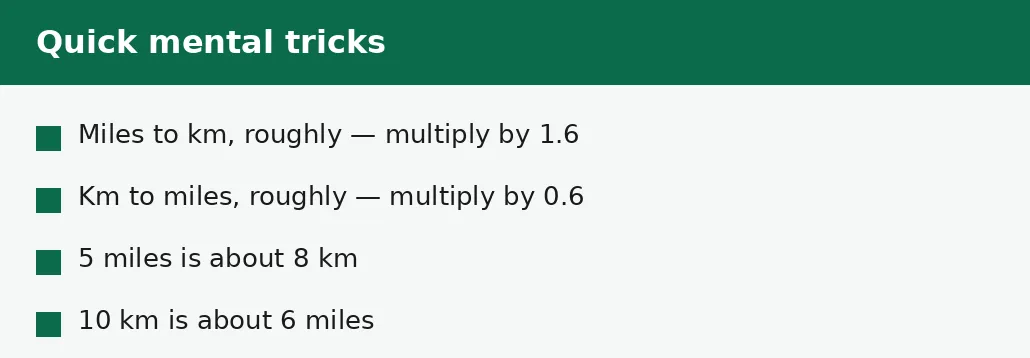
For a quick estimate, multiply miles by 1.6: 10 miles is about 16 kilometres, 50 miles about 80, 100 miles about 160. The estimate is within half a percent of the exact figure, which is close enough for a road sign or a conversation, and the arithmetic is easy to do in your head. The other direction is multiply kilometres by 0.6: 10 kilometres is about 6 miles, 50 about 30, 100 about 60.
A sharper trick uses the 5-to-8 ratio: 5 miles is almost exactly 8 kilometres — 8.04672, to be precise — so any distance in miles can be estimated by taking five-eighths of it in kilometres, or the other way round. Five miles is 8 kilometres, ten miles is 16, fifty miles is 80, and the error stays under one percent. For anything where the number matters — a race entry, a formal document, a navigation setting — use the exact factor, not the trick.
The mistakes to avoid
The most common mistake is mixing miles with nautical miles: a nautical mile is 1.852 kilometres, considerably longer than a land mile's 1.60934, and it belongs to sea and air navigation, not to roads and races. A distance given in nautical miles converted with the land-mile factor is wrong by 15 percent — enough to miss a destination or misjudge a race.
The second mistake is rounding too early: converting the marathon's 26.219 miles with the factor rounded to 1.61 gives 42.213 kilometres, not 42.195 — an error of about 18 metres, which matters to a runner and to an official measurement. Keep the full factor through the multiplication, and round only the result. And the third mistake is converting speed with the distance factor: miles per hour and kilometres per hour convert with the same factor, but the conversion is of the speed, not of the distance — use the speed converter for speeds.
More unit guides
Distance is one of several unit families on this site, and each has its own complete guide. The inches and centimetres guide covers small lengths — screens, heights, paper. The kilograms and pounds guide covers weight, and the litres and gallons guide covers volume for fuel, cooking and tanks. All of them use the same pattern: an exact factor or formula, a table of the common values, and the everyday uses.
Troubleshooting
Why does my conversion not match the road sign?
Either the sign was rounded, or the distance was measured along a different route. The factor is exact — 1 mile is 1.60934 kilometres — so a mismatch comes from the input distance or the rounding, never from the factor.
Why is a nautical mile different?
Because it is a different unit: a nautical mile is 1.852 kilometres, defined from the Earth's circumference for sea and air navigation, while a land mile is 1609.34 metres. They share the word mile and nothing else.
Why did rounding change my race distance?
Because the factor was rounded before the multiplication. Keep the full 1.60934 through the calculation and round only the result — rounding 1.60934 to 1.61 first costs a marathon about 18 metres.
Common questions
How many kilometres are in a mile?
Exactly 1.60934 kilometres, because one mile is defined as exactly 1609.34 metres. The factor is exact, by definition — the only errors in a conversion come from rounding the result.
How do I convert miles to kilometres?
Multiply the miles by 1.60934. A 26.2-mile marathon is 42.195 kilometres, and a 100-mile road trip is 160.934 kilometres.
How do I convert kilometres to miles?
Divide the kilometres by 1.60934, or multiply by 0.621371. A 10-kilometre run is 6.21371 miles, and 100 kilometres is 62.1373 miles.
How many miles is a marathon?
42.195 kilometres is 26.219 miles — 26 miles 385 yards — commonly quoted as 26.2 miles. A half marathon is 21.0975 kilometres, or 13.109 miles, commonly quoted as 13.1.
What is the quick way to estimate miles to kilometres?
Multiply miles by 1.6 for a quick estimate — 10 miles is about 16 kilometres. Or use the 5-to-8 ratio: 5 miles is almost exactly 8 kilometres. Use the exact factor when the number matters.
Is a nautical mile the same as a mile?
No. A nautical mile is 1.852 kilometres, used in sea and air navigation, while a land mile is 1.60934 kilometres. Converting one with the other's factor is wrong by about 15 percent.
Summary
One mile is exactly 1.60934 kilometres. Multiply miles by 1.60934 to get kilometres, divide kilometres by 1.60934 — or multiply by 0.621371 — to get miles. A marathon is 42.195 kilometres — 26 miles 385 yards, commonly rounded to 26.2 miles; a 10-kilometre run is 6.21 miles. For a quick estimate, multiply by 1.6 — but use the exact factor when the number matters, keep the full factor through the multiplication, and do not confuse land miles with nautical miles.