Inches and centimetres: the complete conversion guide
Last updated: 9 November 2026.
One inch is exactly 2.54 centimetres, and one centimetre is 0.393701 inches. To convert inches to centimetres, multiply by 2.54 — 6 inches is 6 times 2.54, which is 15.24 centimetres. To convert centimetres to inches, divide by 2.54 — 15 centimetres is 15 divided by 2.54, which is 5.91 inches. The factor is exact by definition: the inch has been defined as 25.4 millimetres since 1959, so the conversion never drifts. The practical uses are screens, heights, paper sizes and anything measured in both systems at once.
The definition: why the factor is exact
The inch is defined as exactly 25.4 millimetres, by international agreement since 1959 — which makes one inch exactly 2.54 centimetres. Like the pound in the kilograms and pounds guide, the inch is defined in metric units, so the conversion factor is a definition, not a measurement: it never changes, never needs updating, and any two converters that disagree are rounding differently rather than disagreeing about the factor.
The centimetre is the metric side of the same relationship: one centimetre is one hundredth of a metre, and one inch is 2.54 of them. The two systems meet at exactly this number, which is why the conversion is one of the cleanest in measurement — a single multiplication, no offset, no second factor, nothing to remember except 2.54.
How to convert inches to centimetres
Multiply the inches by 2.54. Six inches is 6 times 2.54, which is 15.24 centimetres. Fifty-five inches — a television — is 55 times 2.54, which is 139.7 centimetres. To go the other way, divide by 2.54: 15 centimetres is 15 divided by 2.54, which is 5.91 inches, and 175 centimetres is 175 divided by 2.54, which is 68.9 inches.
Heights need one extra step, because height is usually given in feet and inches together: 5 feet 9 inches is 5 times 12 plus 9, which is 69 inches, and 69 times 2.54 is 175.26 centimetres. Convert the feet to inches first, add the inches, then multiply once — converting the feet and the inches separately and adding the results is the same arithmetic with more chances to slip.
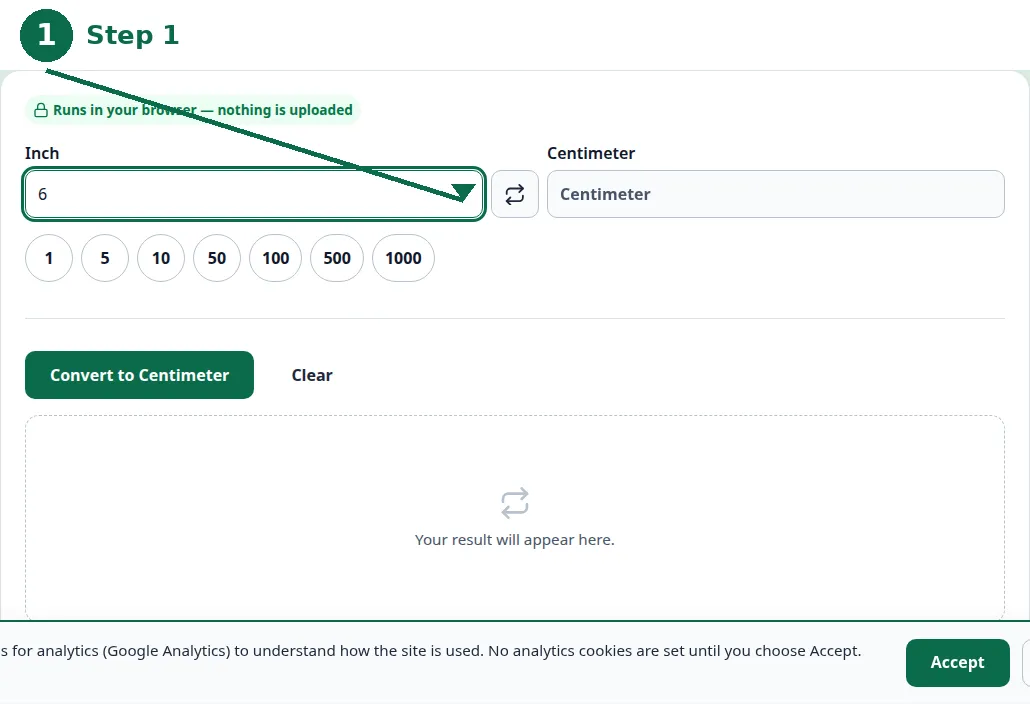
- Step 1 — Open the Inches to Centimetres tool and enter the length in inches.
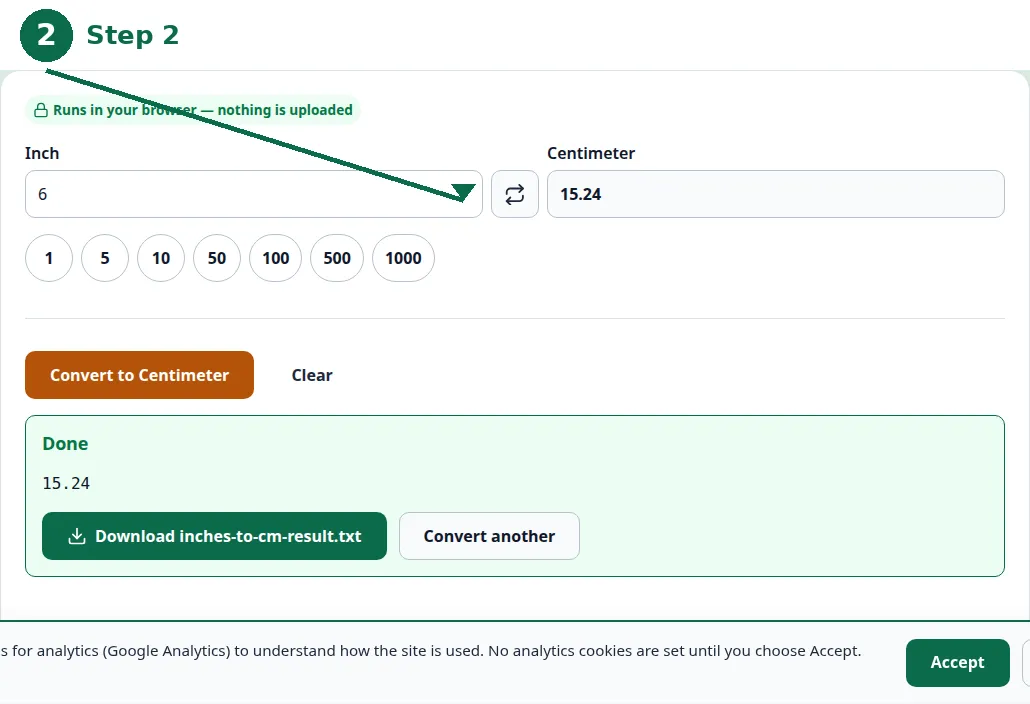
- Step 2 — Click Convert and read the result in centimetres.
- Step 3 — For a height in feet and inches, convert the feet to inches first, add them, then convert once.
- Step 4 — Check the rounding: two decimal places for a fitting, whole centimetres for a rough answer.
The formula, both directions
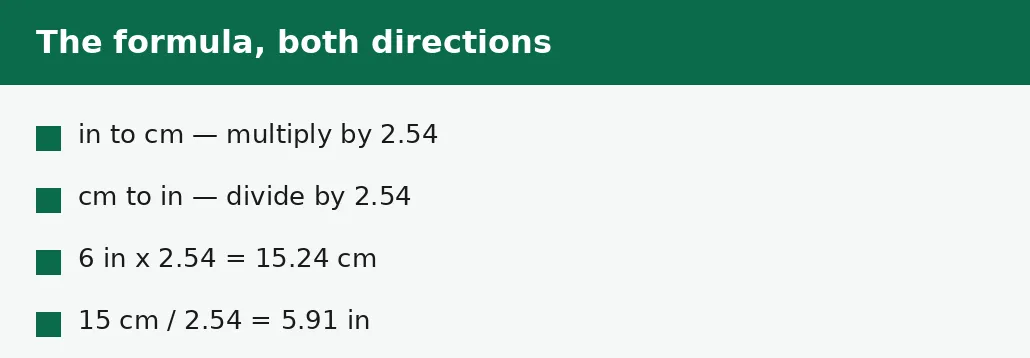
Centimetres equal inches times 2.54. Inches equal centimetres divided by 2.54, which is the same as centimetres times 0.393701. There is nothing else to it: no offset, no correction, no second factor. It is the same shape as the kilograms-to-pounds conversion — a single multiplication one way and a single division the other — and it is checked the same way, by converting the answer back and landing on the number you started with.
Millimetres are the finer metric unit in the same family: one inch is 25.4 millimetres, and one millimetre is 0.03937 inches. A measurement in millimetres converts to inches by dividing by 25.4, which is the same factor with the decimal point moved — and the same exactness, because the inch is defined in millimetres in the first place.
Conversion table: inches to centimetres
The lengths people actually convert are screen diagonals, heights, paper sizes and small measurements, and they cluster in a narrow range. The table below covers the common ones, worked to two decimal places — the precision that matters for a screen, a shelf and a fitting.
For values outside the table, the formula is the tool: multiply by 2.54 and round to the precision the job needs. A television needs one decimal place; a shelf needs the nearest millimetre; a rough answer needs whole centimetres.
| Inches | Centimetres | Used for |
|---|---|---|
| 1 in | 2.54 cm | A thumbnail, a small part. |
| 5 in | 12.7 cm | A small phone screen. |
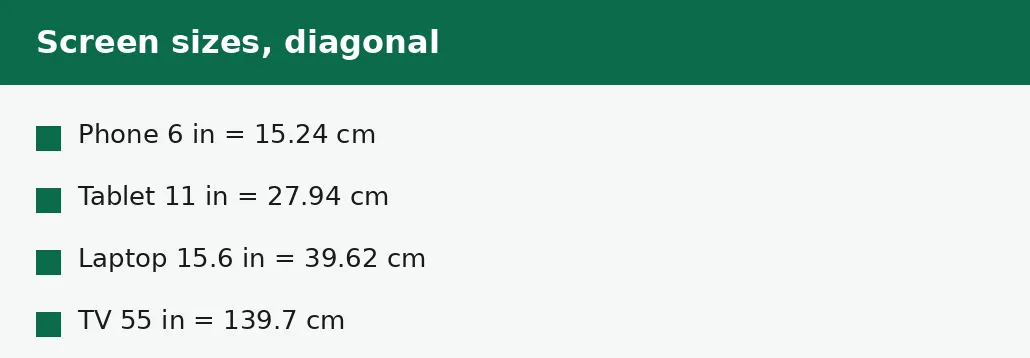
| 6 in | 15.24 cm | A phone screen, diagonal. |
| 11 in | 27.94 cm | A tablet screen, diagonal. |
| 15.6 in | 39.62 cm | A laptop screen, diagonal. |
| 32 in | 81.28 cm | A small TV, diagonal. |
| 55 in | 139.7 cm | A living-room TV, diagonal. |
| 69 in | 175.26 cm | A height of 5 ft 9 in. |
| 72 in | 182.88 cm | A height of 6 ft. |
Everyday uses: screens, height and paper
Screens are the most common conversion, and the one with a trap: screen sizes are measured diagonally, corner to corner, not across the width. A 55-inch television is 139.7 centimetres diagonally, but its width is about 121 centimetres and its height about 68 — the diagonal is the headline number, and the width is what decides whether it fits on the wall. Always check whether the number you have is the diagonal or the width before you convert.
Height is the second use: 5 feet 9 inches is 175.26 centimetres, and 6 feet is 182.88 centimetres. Paper is the third: A4 paper is 21 by 29.7 centimetres, which is 8.27 by 11.69 inches, and US Letter is 8.5 by 11 inches, which is 21.59 by 27.94 centimetres — close to A4, but not the same, which is why a document formatted for one can print slightly wrong on the other.
The mistakes to avoid
The most common mistake is converting the wrong way: dividing when you should multiply, and ending up with 6 inches as 2.36 centimetres — a number that should look obviously wrong, since an inch is more than two centimetres, so the centimetres number must always be bigger than the inches number. If the centimetres came out smaller, the direction is reversed.
The second mistake is measuring a screen across the width and calling it the diagonal: a 55-inch television measured across is about 48 inches wide, and converting the width as if it were the diagonal gives a television that does not exist. And the third mistake is rounding too early for a fitting: 2.5 instead of 2.54 is fine for a rough answer, but over 55 inches the rounding costs more than 2 centimetres — the difference between fitting and not fitting.
More unit guides
Length is one of several unit families on this site, and each has its own complete guide. The miles and kilometres guide covers distance for driving and running — the long end of length. The kilograms and pounds guide covers weight, and the litres and gallons guide covers volume. All of them use the same pattern: an exact factor or formula, a table of the common values, and the everyday uses.
Troubleshooting
Why is my centimetres number smaller than my inches number?
The conversion is backwards. An inch is 2.54 centimetres, so the centimetres number must always be bigger. Multiply inches by 2.54 — do not divide.
Why does my TV not fit the space I measured?
Screen sizes are measured diagonally, not across the width. A 55-inch TV is 139.7 cm diagonally but only about 121 cm wide. Measure the width separately before you buy.
Why is my height conversion off by a few centimetres?
Heights in feet and inches must be combined first: 5 feet 9 inches is 69 inches, and 69 times 2.54 is 175.26 cm. Converting the feet and inches separately and adding the rounded results loses precision.
Common questions
How many centimetres is 1 inch?
Exactly 2.54 centimetres. The inch is defined as 25.4 millimetres, so the factor is exact by definition.
How do I convert inches to centimetres?
Multiply the inches by 2.54. 6 inches is 6 times 2.54, which is 15.24 centimetres.
How do I convert centimetres to inches?
Divide the centimetres by 2.54. 15 centimetres is 15 divided by 2.54, which is 5.91 inches.
How many centimetres is 5 feet 9 inches?
175.26 centimetres. 5 feet 9 inches is 69 inches, and 69 times 2.54 is 175.26.
Are screen sizes measured diagonally?
Yes. A 55-inch television is 139.7 cm diagonally — its width is about 121 cm and its height about 68 cm. Check the width separately when measuring a space.
Is 2.5 a good enough conversion factor?
For a rough answer, yes. For a fitting, a screen or a precise job, use 2.54 — over 55 inches the rounding costs more than 2 centimetres.
Summary
One inch is exactly 2.54 centimetres; multiply inches by 2.54 to get centimetres, divide to go back. Six inches is 15.24 centimetres, and the centimetres number must always be bigger than the inches number. Remember that screens are measured diagonally, and that heights in feet and inches must be combined before converting.