Celsius and Fahrenheit: formulas, chart and quick mental tricks
Last updated: 8 November 2026.
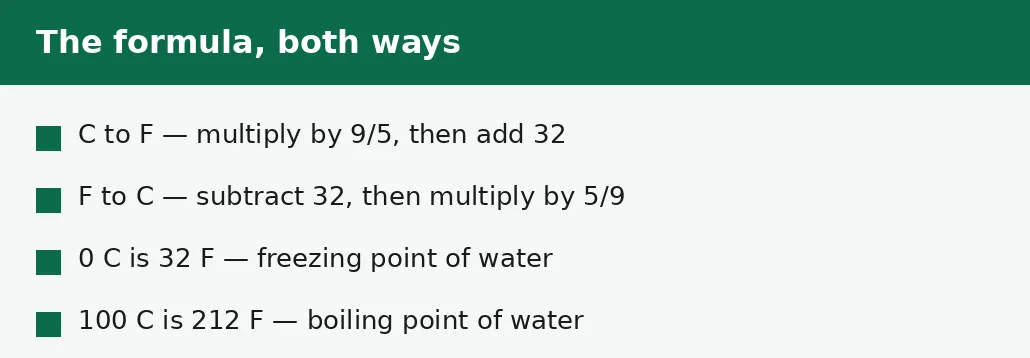
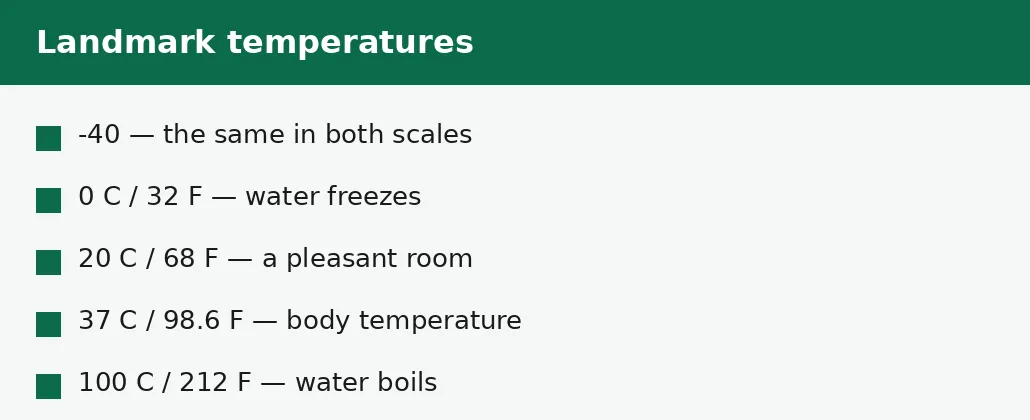
To convert Celsius to Fahrenheit, multiply the Celsius temperature by nine-fifths and add 32: Fahrenheit equals Celsius times 9/5, plus 32. So 20 degrees Celsius is 68 Fahrenheit, 0 Celsius is 32 Fahrenheit, and 100 Celsius is 212 Fahrenheit. The other direction is the reverse: subtract 32 from the Fahrenheit temperature, then multiply by five-ninths. And the two scales meet at exactly one temperature: minus 40 is minus 40 in both.
Why there are two scales
Celsius and Fahrenheit measure the same thing — how hot or cold something is — but they start in different places and count in different steps. Celsius starts at the freezing point of water, 0 degrees, and counts to 100 at water's boiling point: a scale built on water, with 100 degrees between its two landmarks. Fahrenheit starts lower, at 32 degrees for freezing water, and reaches 212 at boiling: 180 degrees between the same two landmarks.
Most of the world uses Celsius; the United States uses Fahrenheit, and so do a few other places. That is why the conversion is needed constantly — weather forecasts, oven settings, travel, recipes — and why the formula is worth knowing rather than looking up every time. The two scales are not two different kinds of temperature; they are two rulers for the same thing, with different zeros and different step sizes.
The formula, both directions
Celsius to Fahrenheit: multiply the Celsius temperature by nine-fifths, then add 32. In symbols, F equals C times 9/5, plus 32. The multiplication stretches the Celsius degrees to Fahrenheit size — a Fahrenheit degree is smaller than a Celsius degree, so there are more of them — and the plus 32 shifts the zero from water's freezing point in Celsius to water's freezing point in Fahrenheit.
Fahrenheit to Celsius is the reverse, in reverse order: subtract 32 first, then multiply by five-ninths. In symbols, C equals F minus 32, times 5/9. A worked example both ways: 20 degrees Celsius times 9/5 is 36, plus 32 is 68 — so 20°C is 68°F. And 68°F minus 32 is 36, times 5/9 is 20 — so 68°F is 20°C. The two directions undo each other exactly, as they must.
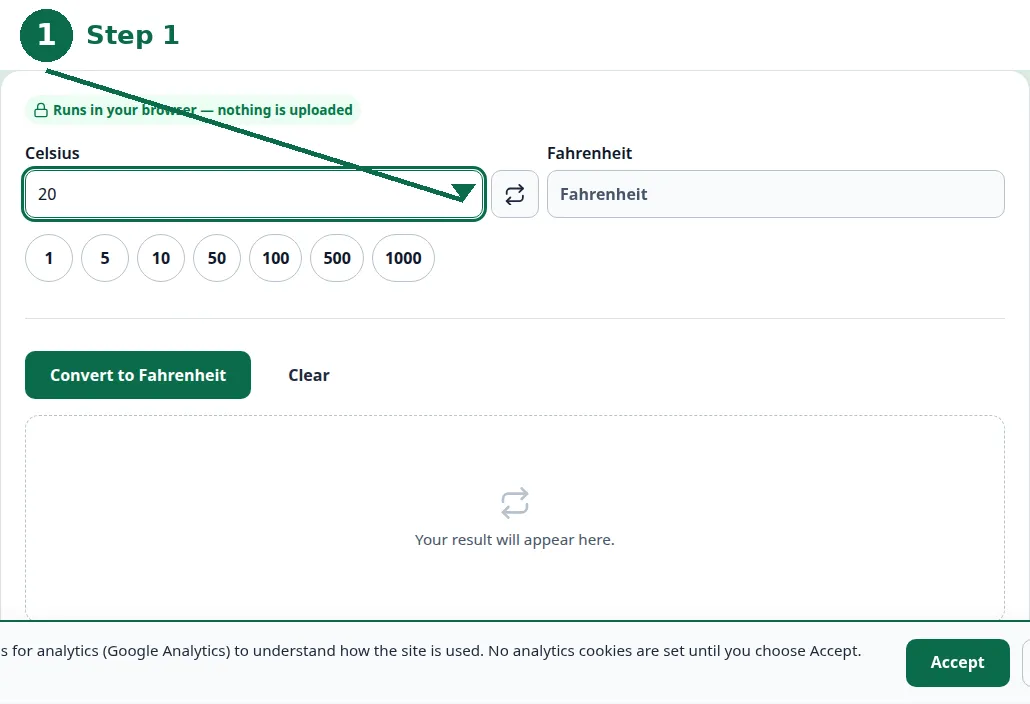
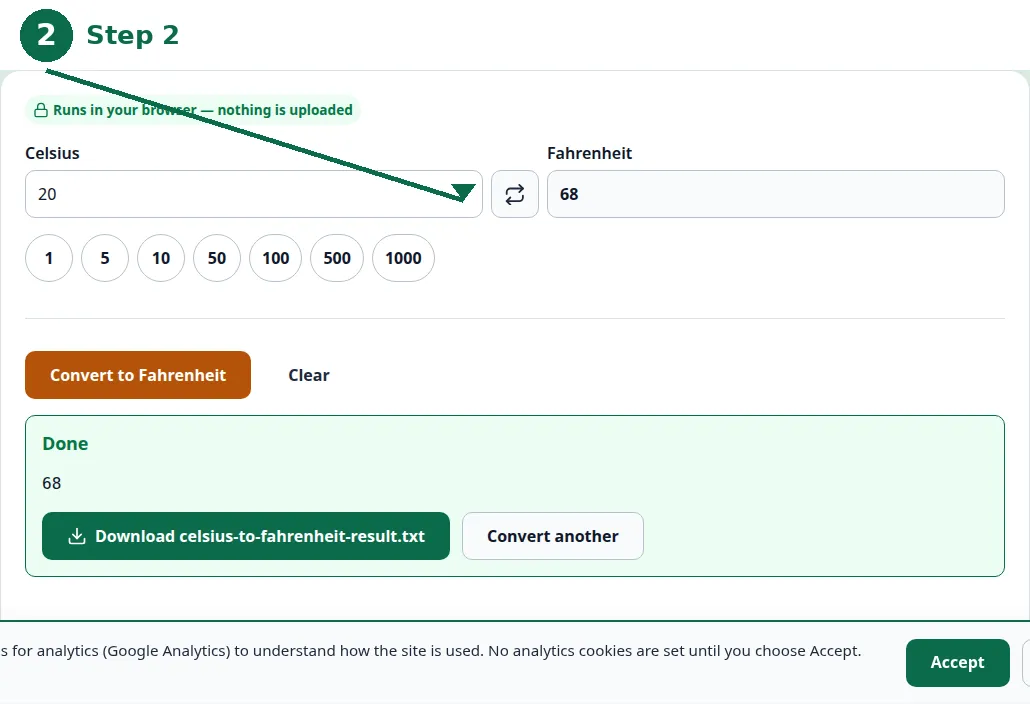
- Step 1 — Open the Celsius to Fahrenheit converter and enter the temperature.
- Step 2 — Click Convert and read the Fahrenheit result.
- Step 3 — For the other direction, use the Fahrenheit to Celsius converter, or subtract 32 and multiply by 5/9.
- Step 4 — Round to the precision the job needs — whole degrees for weather, one decimal for body temperature.
Conversion chart: Celsius to Fahrenheit
The chart below gives the common temperatures in both scales, worked with the formula and rounded to one decimal where the exact figure needs it. Weather, cooking and body temperature are the ones people look up most — and the landmarks are worth learning by heart, because they make the scale readable without a converter: freezing, room temperature, body temperature and boiling.
For temperatures beyond the chart, the formula is the chart: multiply by 9/5 and add 32, or use the converter, which applies the exact formula to any value you enter, including negatives and decimals. The converter is the better tool for an unusual number, because it never rounds the factor — it applies the formula exactly every time.
| Celsius | Fahrenheit | What it is |
|---|---|---|
| -40 | -40 | The two scales meet. |
| -20 | -4 | A very cold day. |
| -10 | 14 | A cold winter day. |
| 0 | 32 | Water freezes. |
| 10 | 50 | A cool day. |
| 20 | 68 | A pleasant room. |
| 25 | 77 | A warm day. |
| 30 | 86 | A hot day. |
| 37 | 98.6 | Body temperature. |
| 100 | 212 | Water boils. |
| 180 | 356 | A moderate oven. |
| 200 | 392 | A hot oven. |
Quick mental tricks
For weather, the double-and-add-30 trick is close enough: double the Celsius temperature and add 30, and the result is within a few degrees of the true Fahrenheit. Twenty degrees Celsius doubles to 40, plus 30 is 70 — the true answer is 68, so the trick is 2 degrees high, which is fine for deciding whether to take a jacket. Thirty degrees doubles to 60, plus 30 is 90 — the true answer is 86, so the trick is 4 degrees high on a hot day, still fine for weather.
The other direction is subtract 30 and halve: 68 Fahrenheit minus 30 is 38, halved is 19 — the true answer is 20, so the trick is a degree low. A sharper trick for Celsius to Fahrenheit is to double, subtract a tenth, and add 32: 20 doubled is 40, minus 4 is 36, plus 32 is 68 — exact. That version is worth learning when the number matters more, because it is the formula done in easy steps.
Temperature differences are a different question
Converting a temperature and converting a temperature difference are different jobs, and mixing them up is the most common error with these scales. A temperature of 20°C is 68°F, but a rise of 20°C is a rise of 36°F, not 68 — because the plus 32 in the formula is a shift of the zero, and a difference has no zero to shift. The rule for differences is simple: multiply by 9/5, and do not add 32.
So a day that warms by 10°C warms by 18°F, an oven turned up by 20°C is turned up by 36°F, and a fever that rises by 2°C rises by 3.6°F. The converter on this site converts temperatures, not differences — for a difference, multiply by 9/5 and stop there.
The mistakes to avoid
The most common mistake is adding 32 before multiplying instead of after: 20 times 9/5 is 36, plus 32 is 68 — but 20 plus 32 is 52, times 9/5 is 93.6, which is wrong by more than 25 degrees. The order matters, and the formula's order is multiply first, add second. The other direction has the same trap: subtract 32 first, then multiply — multiplying first gives a wrong answer by the same kind of margin.
The second mistake is using the temperature formula for a temperature difference, covered above: a rise of 10°C is 18°F, not 50°F. And the third is trusting a rounded factor: nine-fifths is 1.8 exactly, so there is no rounding in the factor itself — but rounding the result too early, to a whole degree when a decimal matters, is a real error for body temperature and for cooking.
Troubleshooting
Why is my conversion 25 degrees out?
The 32 was added before the multiplication instead of after. The formula is multiply by 9/5 first, then add 32 — doing it the other way round adds an extra 25 degrees.
Why is a rise of 10°C not 50°F?
Because a temperature difference has no zero to shift: multiply by 9/5 and stop. A rise of 10°C is a rise of 18°F. The plus 32 belongs to temperatures, not to differences.
Why is -40 the same in both scales?
Because the two scales cross there: minus 40 Celsius times 9/5 is minus 72, plus 32 is minus 40. It is the one temperature where the two rulers agree.
Common questions
What is 20°C in Fahrenheit?
68°F. The formula is Fahrenheit equals Celsius times 9/5, plus 32, so 20 times 9/5 is 36, plus 32 is 68.
What is 100°C in Fahrenheit?
212°F — the boiling point of water. And 0°C is 32°F, the freezing point of water.
How do I convert Fahrenheit to Celsius?
Subtract 32, then multiply by 5/9. So 68°F minus 32 is 36, times 5/9 is 20°C.
What is body temperature in Fahrenheit?
37°C is 98.6°F, the usual figure quoted for normal body temperature.
What is the quick way to estimate Celsius to Fahrenheit?
Double the Celsius and add 30 — close enough for weather. For an exact answer, double, subtract a tenth, and add 32.
Is -40 the same in Celsius and Fahrenheit?
Yes. Minus 40 is the one temperature where the two scales agree: -40°C equals -40°F.
Summary
Celsius to Fahrenheit: multiply by 9/5, then add 32. Fahrenheit to Celsius: subtract 32, then multiply by 5/9. The landmarks are 0°C is 32°F, 20°C is 68°F, 37°C is 98.6°F, and 100°C is 212°F — and the scales meet at -40. For a quick estimate, double and add 30; for a temperature difference, multiply by 9/5 and do not add 32.