How many words? Word counts for essays, applications and social posts
Last updated: 8 November 2026.
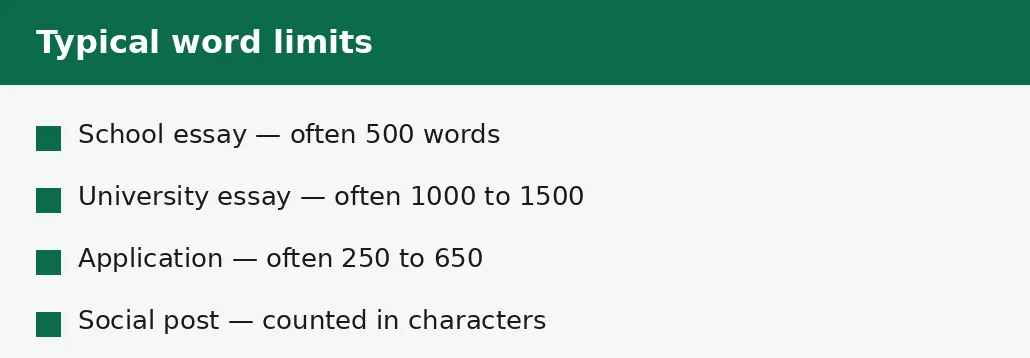
The word count that matters is the one on the instructions you were given: a school essay is often 500, 1000 or 1500 words, a university application often 250 to 650, a social post often 280 characters rather than words at all. There is no universal right length — the right length is the limit you were set, and the job is to land inside it without padding or cutting meaning. Count with the same rules the reader will use: a word is a run of characters separated by whitespace, and the counter on this site counts exactly that way.
Why the count matters
A word limit is not a suggestion: it is a test of whether you can say what matters inside a boundary. An essay over the limit can be penalised or rejected outright; an application over the limit can be cut off mid-sentence by the form; a social post over the character limit simply cannot be posted. The limit is part of the assignment, and meeting it is part of the work.
The limit also protects the reader: a marker reading a hundred essays, an admissions officer reading a thousand applications, a follower scrolling a feed — all of them need the writing to be as long as it needs to be and no longer. A text that lands inside its limit, with room to spare, reads as disciplined; a text that strains against the limit reads as undisciplined, whatever it says.
How to count your words
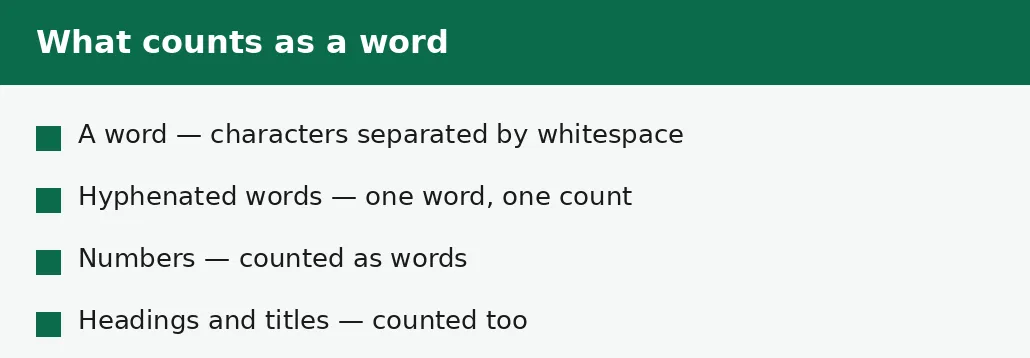
Paste the text into the counter, read the count, and compare it with the limit on your instructions. The counter on this site counts a word as a run of characters separated by whitespace — the plain rule the existing word counter guide explains in full, including why two counters can disagree: hyphenated words, numbers, and headings are the usual points of difference, and the rules are stated there so you can check them.
Count the text you will actually submit, not a draft of it: the title, the headings and the references, if the instructions say they count — and they often do, unless the instructions say otherwise. Count before you submit, not after, and count again after every edit, because a single added paragraph can push a text that was inside the limit over it.
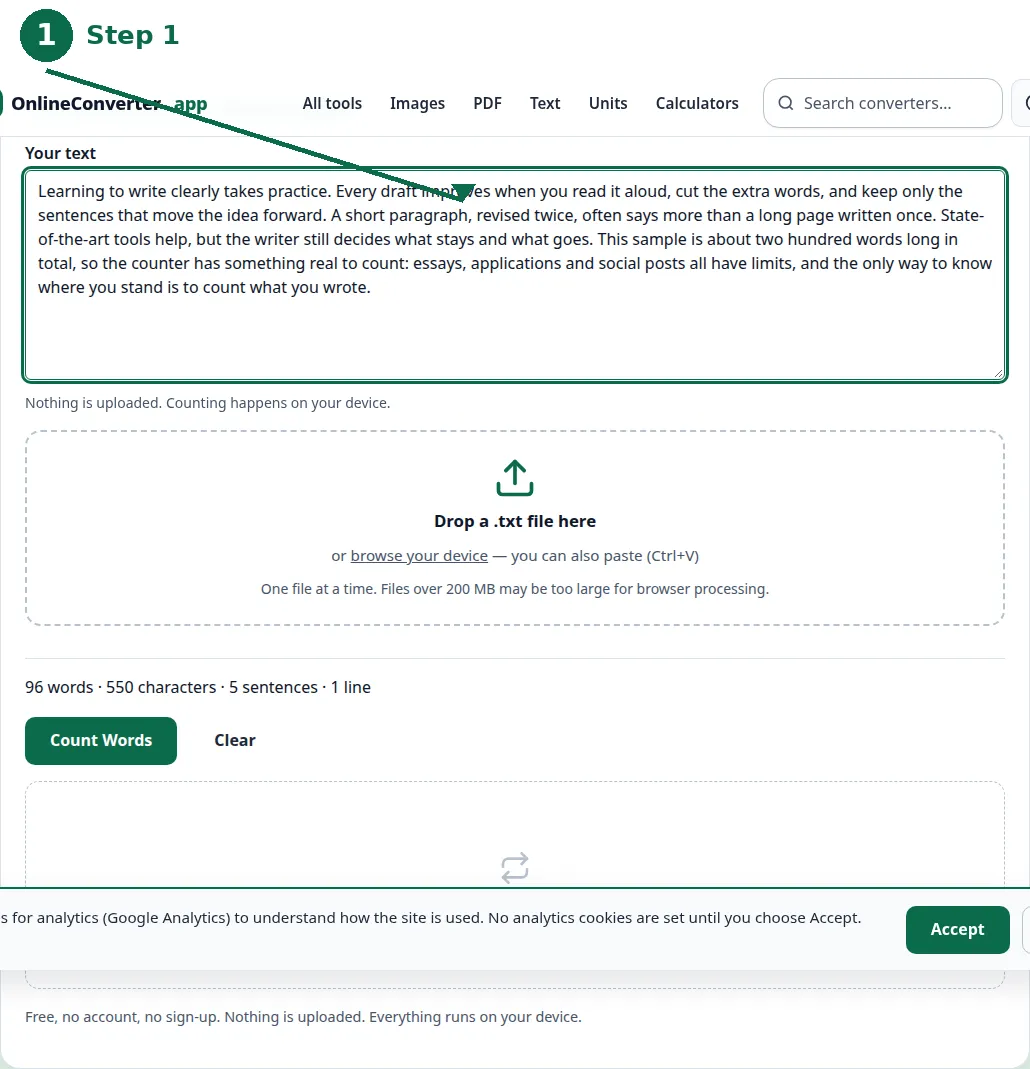
- Step 1 — Open the Word Counter and paste the text you will actually submit.
- Step 2 — Read the word count, and the character count beside it.
- Step 3 — Compare the count with the limit on your instructions.
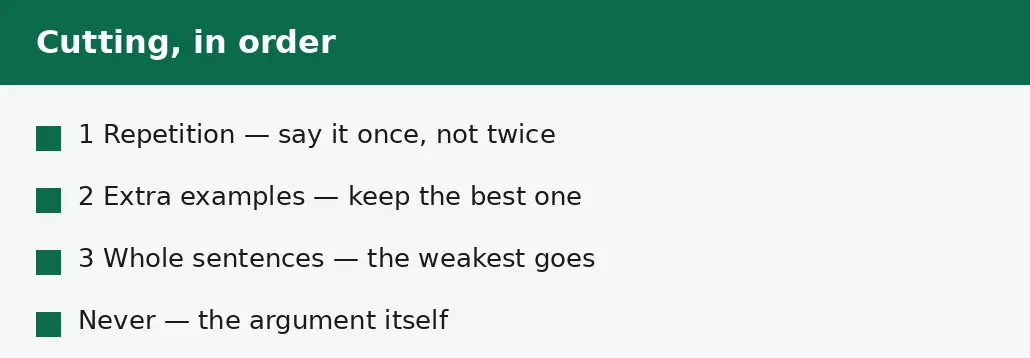
- Step 4 — If you are over, cut in order: repetition, then examples, then sentences — and count again.
Essays: 500, 1000, 1500 words
School essays are often set at 500 words: long enough for an argument with evidence, short enough to mark. University essays are often 1000 to 1500 words: long enough for a developed argument with several points, short enough to keep the writer honest. Longer essays — 2000, 3000, 5000 words — are usually divided into sections, and the count that matters is the total, not the count of any one section.
The way to hit an essay length is to plan in paragraphs: a 1000-word essay is roughly six to eight paragraphs of 120 to 150 words each, and a 500-word essay is three to four. Write the argument first, then count, then cut or expand: a text that is 10 percent over can be cut by removing repetition; a text that is 10 percent under usually needs another example or a fuller explanation, not padding.
| Text | Typical limit | Notes |
|---|---|---|
| School essay | 500 words | Three to four paragraphs. |
| University essay | 1,000-1,500 words | Six to ten paragraphs. |
| University application | 250-650 words | Often a strict maximum. |
| Cover letter | 250-400 words | One page, at most. |
| Social post | 280 characters | Counted in characters, not words. |
| Abstract | 150-300 words | A summary, not the paper. |
Applications: short, strict, and counted
Application word limits are usually strict maxima, not targets: a 650-word limit means 650 or fewer, and a 250-word limit means the whole case must be made in a paragraph or two. The form often counts for you and cuts off the text at the limit, so a text that is over is not penalised — it is truncated, mid-sentence, and the reader sees the cut. That is why applications are counted before they are pasted, never after.
The way to write inside a short limit is to choose one point and make it well, rather than listing everything: an application that says one thing clearly beats one that says five things thinly. Cut the background first — the reader knows the context — then cut the second example, then cut the adjectives. What remains should be the claim, the evidence, and nothing else.
Social posts: characters, not words
Social posts are usually counted in characters, not words, and the character count includes spaces and punctuation: a post of 280 characters is roughly 40 to 50 words, depending on word length, and a post of 500 characters is roughly 80 words. The counter on this site shows the character count beside the word count, so the same paste answers both questions.
The discipline for posts is different from essays: the first line carries the post, because a reader who does not stop at the first line never reads the second. Write the point first, then the detail, and cut the post to the limit by removing words from the end — the end is where the padding lives, and the beginning is where the reader is.
Cutting without cutting meaning
Cut in order: repetition first, then examples, then sentences. Repetition is the easiest cut — the same point made twice, the same phrase in two paragraphs — and removing it loses nothing. Examples are next: keep the best one, cut the rest, because one good example proves a point and three prove it no better. Sentences are last: cut the weakest sentence in each paragraph, and the paragraph survives.
Never cut the argument itself: a text that is inside the limit but has lost its point has not been fixed, it has been ruined. And never pad a text that is under the limit: padding is visible — repeated phrases, empty intensifiers, sentences that say nothing — and a marker or reader notices it before they notice the count. A text that is honestly shorter than the limit is better than a text padded up to it.
Troubleshooting
Why does my count differ from the form's count?
Because the counting rules differ: hyphenated words, numbers, headings and titles are counted differently by different counters. Check the rules in the word counter guide, and count with the same rules the reader will use — or paste into the form's own counter, if it has one.
Why was my application cut off mid-sentence?
Because the form truncates text at the limit instead of rejecting it. Count before you paste, and paste a text that is already inside the limit — never paste first and hope.
Why is my essay under the limit but still marked down?
Because length is not the only criterion: an essay under the limit usually needs another example or a fuller explanation, not padding. Add substance, not words.
Common questions
How many words is a typical essay?
A school essay is often 500 words; a university essay is often 1,000 to 1,500 words. The count that matters is the one on your instructions — there is no universal right length.
How many words is a university application?
Often 250 to 650 words, as a strict maximum. The form often truncates text at the limit, so count before you paste, not after.
How many words is a social media post?
Social posts are usually counted in characters, not words: 280 characters is roughly 40 to 50 words. The counter shows the character count beside the word count.
What counts as a word?
A run of characters separated by whitespace — that is how this site's counter counts, and the word counter guide states the full rules, including hyphenated words, numbers and headings.
How do I cut words without losing meaning?
Cut in order: repetition first, then extra examples, then the weakest sentences. Never cut the argument itself, and never pad a text that is under the limit.
Is my text uploaded anywhere when I count it?
No. Counting runs entirely in your browser. Nothing is sent to a server, there is no account, and closing the tab clears your text from memory.
Summary
The count that matters is the one on your instructions: essays are often 500, 1000 or 1500 words, applications often 250 to 650 as a strict maximum, and social posts are counted in characters. Count the text you will actually submit, with the counter's plain rule — a word is characters separated by whitespace — and count again after every edit. Cut repetition, then examples, then sentences; never cut the argument, and never pad.