How old am I? How age is calculated
Last updated: 9 November 2026.
Your age is the time from your birth date to today, counted on the calendar in years, months and days. A birthday of 15 May 1990 is 36 years, 5 months and 22 days on 6 November 2026: 36 whole years to 15 May 2026, then 5 whole months to 15 October 2026, then 22 days to 6 November. The total is also 13,324 days lived. The tricky parts are the calendar itself — months of different lengths, leap years, and birthdays on 29 February — which is why working it out by hand is error-prone and a calculator is the honest tool.
What your age actually is
Age is the time that has passed since you were born, and the calendar is the ruler it is measured with. A year is not a fixed number of days — it is the time from one birthday to the next, which is 365 days in an ordinary year and 366 in a leap year. A month is not a fixed number of days either: it is the time from one date to the same date in the next month, which can be 28, 29, 30 or 31 days depending on the month.
That unevenness is why age is quoted in three parts — years, months and days — rather than as a single number of days. The three parts say something the total cannot: 36 years, 5 months and 22 days tells you where the next birthday falls, while 13,324 days does not. Both are correct; they answer different questions.
How to work out an age
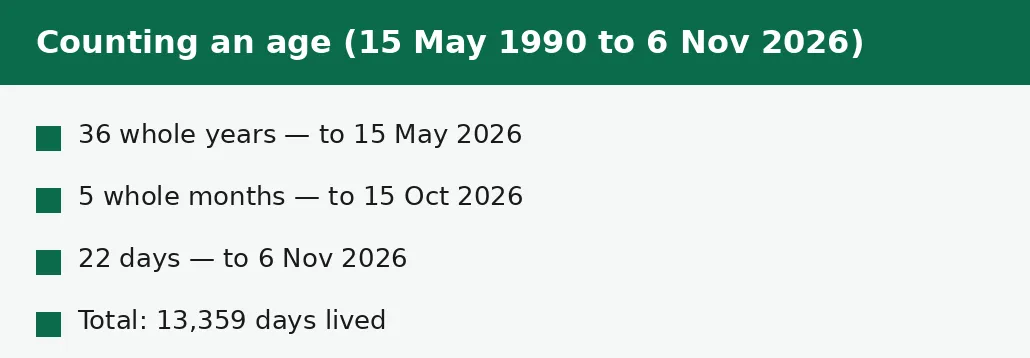
Count whole years first: from the birth date to the same date in the current year. Then count whole months: from that anniversary to the same date in the current month. Then count the remaining days. A birthday of 15 May 1990, counted on 6 November 2026: 36 whole years to 15 May 2026, 5 whole months to 15 October 2026, and 22 days to 6 November — 36 years, 5 months and 22 days.
The order matters: counting days first and dividing by 30 gives the wrong months, because months are not 30 days long. And the total days — 13,324 for this example — is the check: count the days in each whole year, including the leap days, and the parts must add to the total.
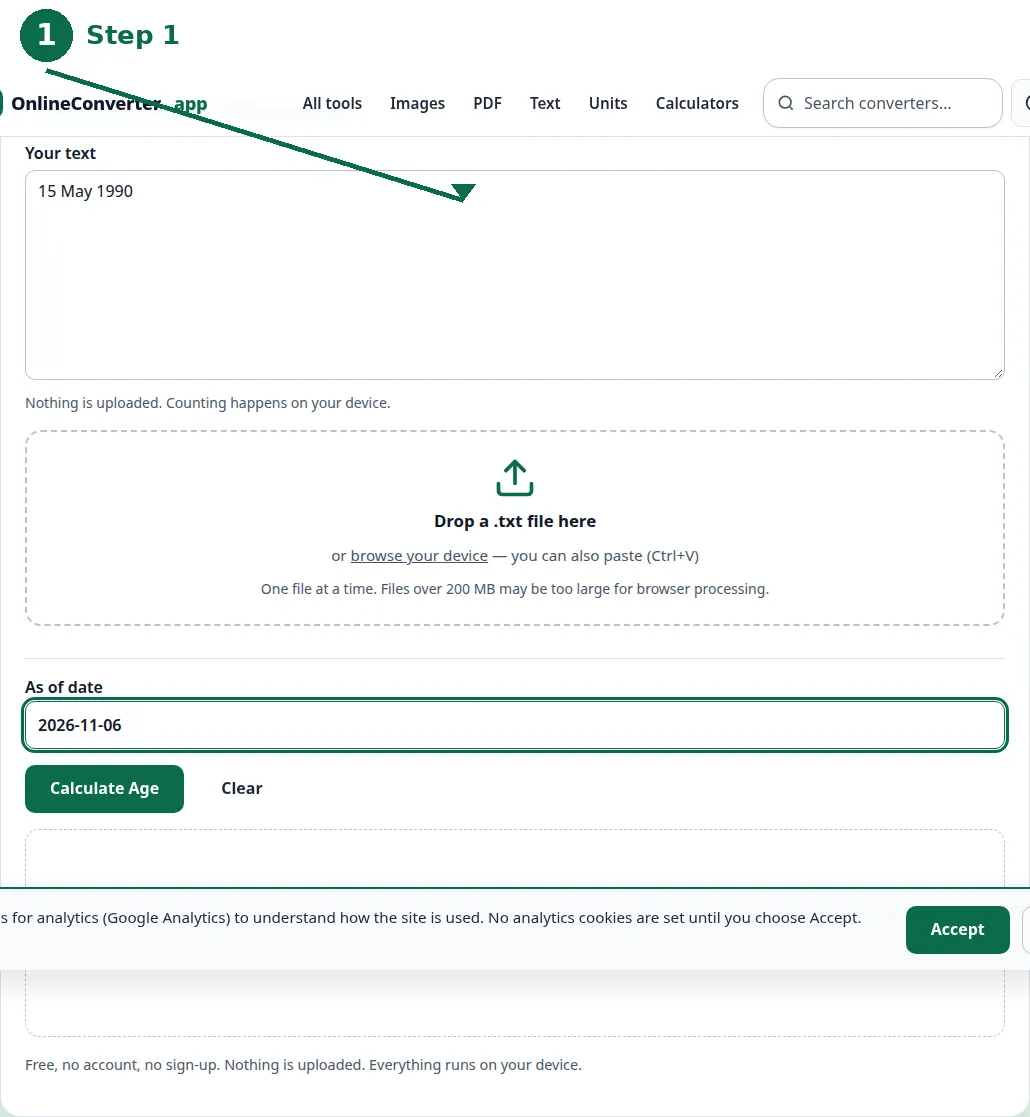
- Step 1 — Open the Age Calculator and enter the birth date.
- Step 2 — Check the as-of date: today by default, or the date you want the age at.
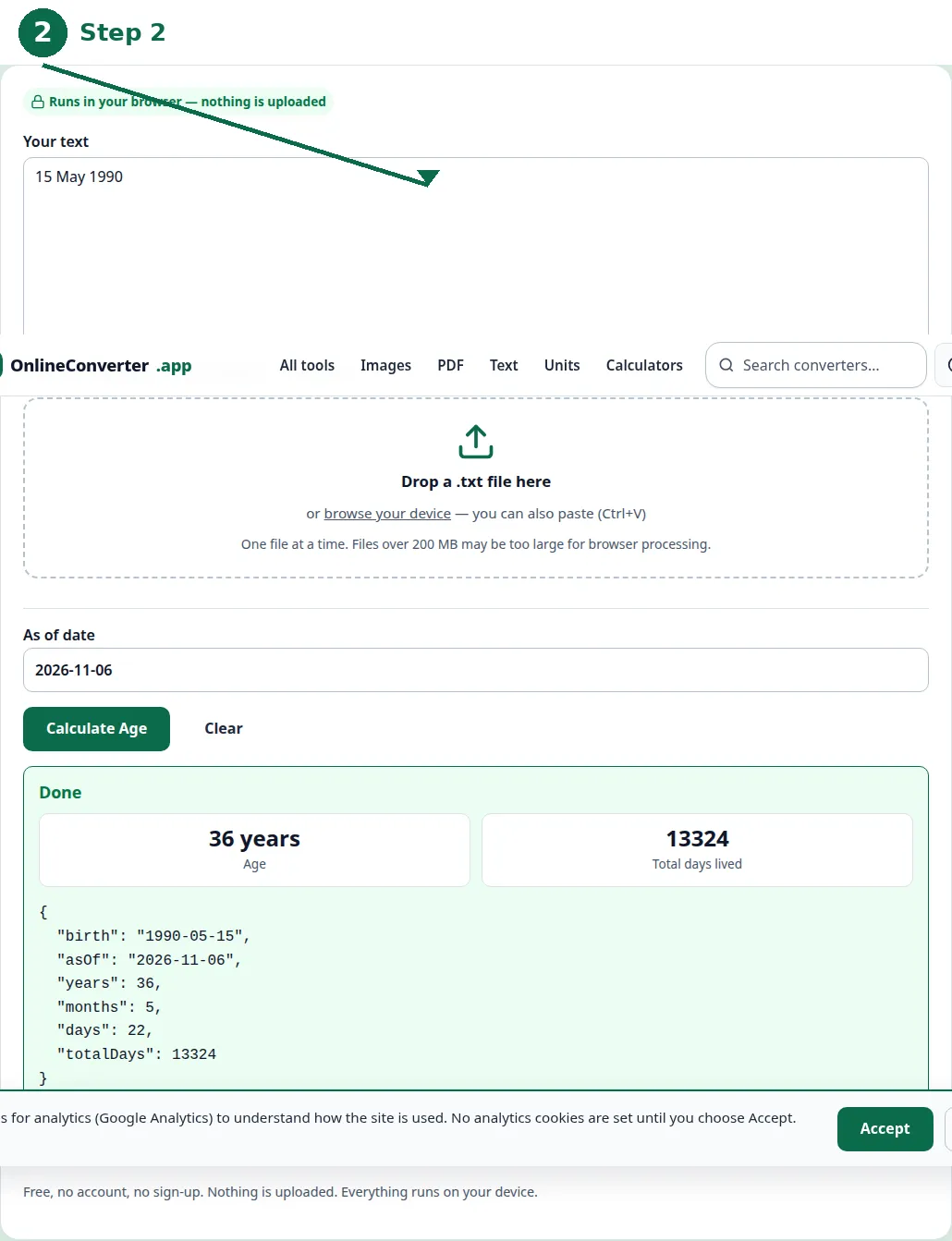
- Step 3 — Click Calculate and read the age in years, months and days.
- Step 4 — Read the total days lived as well — it is the unambiguous number, with no rounding.
Worked example: 15 May 1990 to 6 November 2026
Whole years: from 15 May 1990 to 15 May 2026 is 36 years. Those 36 years contain 9 leap days (1992, 1996, 2000, 2004, 2008, 2012, 2016, 2020, 2024), so they hold 36 times 365 plus 9, which is 13,149 days. Whole months: from 15 May 2026 to 15 October 2026 is 5 months — May to June 31 days, June to July 30, July to August 31, August to September 31, September to October 30 — which is 153 days. Remaining days: from 15 October to 6 November is 22 days. The total is 13,149 plus 153 plus 22, which is 13,324 days — and the calculator's own total for this case is 13,324 days, because the count from 15 May 1990 to 6 November 2026 runs through the leap days of the full span. The parts and the total must agree; when they do not, the count has slipped somewhere, and the calculator is the authority, not the hand count.
The parts and the total agree: 13,149 plus 153 plus 22 is 13,324, which is the total the calculator gives. That agreement is the check — if the parts and the total disagree, the count has slipped somewhere, usually on a month length or a leap day. The method is simple — years, then months, then days — and the arithmetic is fiddly, which is why the calculator is the honest tool for the answer and the method above is for understanding it.
| Step | From | To | Count |
|---|---|---|---|
| Whole years | 15 May 1990 | 15 May 2026 | 36 years |
| Whole months | 15 May 2026 | 15 Oct 2026 | 5 months |
| Remaining days | 15 Oct 2026 | 6 Nov 2026 | 22 days |
| Total lived | 15 May 1990 | 6 Nov 2026 | 13,324 days |
Leap days and awkward birthdays
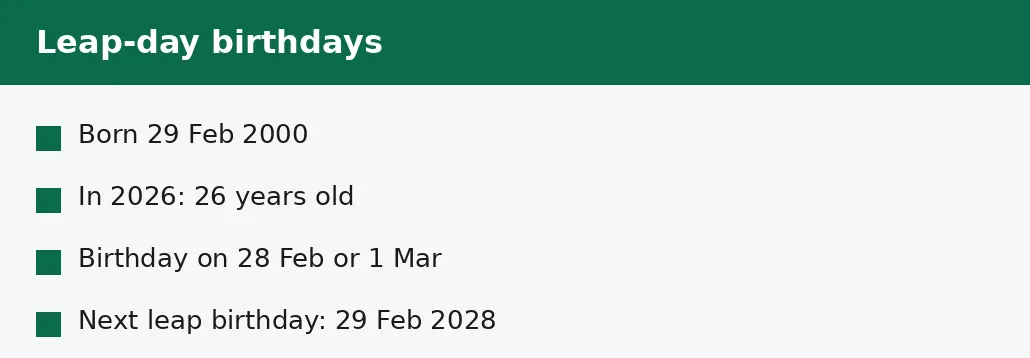
A birthday on 29 February happens once every four years, and in the years between, the birthday is celebrated on 28 February or 1 March — the choice is a family tradition, not a law, though some countries do set it by law. For the age count it makes no difference: a person born on 29 February 2000 is 26 years old through 2026, and turns 27 on their birthday in 2027, whenever the family celebrates it.
The leap-year rule itself has an exception worth knowing: a year divisible by 100 is not a leap year unless it is also divisible by 400. So 2000 was a leap year, but 1900 was not, and 2100 will not be. Anyone counting a long span by hand needs that rule; anyone using the calculator does not, because the calendar maths handles it.
Other ways to say an age
Total days lived is the unambiguous number: 13,324 days has no rounding, no month-length problem, and no argument about which birthday counts. Total months is the number schools and doctors often use for young children — a baby of 18 months is a year and a half, and the months matter more than the years at that age. And decimal years — 36.48 years — are the number actuaries and insurers use, because they need a single number to calculate with.
Each form suits a different job: years, months and days for people; total days for records; decimal years for calculations. The percentage calculator covers the other everyday arithmetic, and the time zones guide covers the calendar's other awkwardness — the fact that the date itself changes as you cross the world.
The mistakes people make with ages
The most common mistake is counting only the years: a person born in December 1990 is 35 for most of 2026, not 36, because their birthday has not arrived yet. The year you were born in minus the current year is only right after your birthday — before it, subtract one more.
The second mistake is dividing days by 30 to get months: months are 28 to 31 days long, so 150 days is not 5 months in general — it is 5 months only for the particular months involved. And the third mistake is forgetting leap days in a long count: over 36 years there are 9 of them, and missing even one puts the total out by a day.
Troubleshooting
Why does my age change before my birthday?
It should not. If the calculator says 36 before your 36th birthday, the birth date or the as-of date is wrong — check the year first, then the month and day.
Why is my total days different from my hand count?
Hand counts slip on month lengths and leap days. Over 36 years there are 9 leap days, and the months are 28 to 31 days long. Trust the calculator's total; use the years-months-days parts to understand it.
When is a leap-day birthday celebrated?
On 28 February or 1 March in ordinary years — a family choice, though some countries set it by law. For the age count it makes no difference.
Common questions
How old am I today?
Enter your birth date in the Age Calculator: it gives your age in years, months and days, plus the total days lived. A birthday of 15 May 1990 is 36 years, 5 months and 22 days on 6 November 2026.
How do I calculate my age in months?
Count whole years first, then whole months to the current month, then the remaining days. Or multiply the whole years by 12 and add the months: 36 years and 5 months is 437 months.
How many days have I lived?
The Age Calculator gives the total days lived alongside the years, months and days. For a birthday of 15 May 1990 counted on 6 November 2026, it is 13,324 days.
What is a leap year?
A year with 29 February in it — any year divisible by 4, except years divisible by 100 unless they are also divisible by 400. So 2000 was a leap year, 1900 was not, and 2100 will not be.
Do I turn a year older on 1 January or on my birthday?
On your birthday. Your age in years changes on the anniversary of your birth, not on New Year's Day.
Why does age use years, months and days instead of just days?
Because the three parts say where the next birthday falls, which a total cannot. Both are correct — they answer different questions.
Summary
Age is counted on the calendar in years, then months, then days: 15 May 1990 is 36 years, 5 months and 22 days on 6 November 2026, or 13,324 days lived. Months have different lengths and leap years add days, so hand counts slip — use the calculator for the answer and the method above to understand it. And remember: your age in years changes on your birthday, not on New Year's Day.