Time zones explained: UTC, GMT and converting between them
Last updated: 8 November 2026.
UTC — Coordinated Universal Time — is the clock the world sets its time zones by: every time zone is UTC plus or minus a number of hours, so London in winter is UTC+0, New York is UTC-5, and Karachi is UTC+5. GMT — Greenwich Mean Time — is the older name for the same idea, and in everyday use the two are treated as the same, though strictly UTC is the precise standard and GMT is the time at Greenwich. To convert a time between zones, convert it to UTC first, then add the other zone's offset — and check the date, because a time that is afternoon in one zone can be tomorrow morning in another.
UTC: the clock the world sets by
UTC — Coordinated Universal Time — is the reference clock for the whole world. It is not the time anywhere in particular, though it matches the time in London in winter: it is the standard against which every time zone is defined. A time zone is simply UTC plus or minus a number of hours: New York is UTC-5 in winter, London is UTC+0 in winter, Karachi is UTC+5 all year, Tokyo is UTC+9 all year. The offset is the whole content of a time zone.
UTC itself is kept by atomic clocks and adjusted with leap seconds so that it stays in step with the Earth's rotation. That precision matters for computers, satellites and science — but for converting a meeting time, the only fact you need is the offset: the number of hours to add or subtract. Everything in this guide follows from that one idea.
UTC vs GMT: the same time, different names
GMT — Greenwich Mean Time — is the older name: the time at the Greenwich observatory in London, from which the world's time zones were first measured. UTC replaced it as the precise standard in the 1960s, because UTC is kept by atomic clocks while GMT is an astronomical measurement, and the two can differ by a fraction of a second. In everyday use, that fraction does not matter, and UTC and GMT are treated as the same time.
You will still see GMT everywhere — on timetables, in broadcasting, in older systems — because it is the familiar name. When a timetable says GMT, it means UTC for all practical purposes, and converting from it works exactly as converting from UTC does. The distinction matters only to astronomers and to systems that need sub-second precision; for a meeting, a flight or a call, UTC and GMT are the same.
How to convert a time between zones
The method is to go through UTC: subtract the first zone's offset to get UTC, then add the second zone's offset to get the new local time. A worked example: it is 3pm in Karachi, which is UTC+5. Subtract 5 hours to get 10am UTC. New York is UTC-5 in winter, so subtract 5 more hours: 5am in New York, the same day. London is UTC+0 in winter, so 10am UTC is 10am in London, the same day.
The arithmetic is simple; the mistakes come from skipping a step. Convert in one jump — Karachi to New York directly — and it is easy to add when you should subtract, or to forget that the offset is 10 hours, not 5. Going through UTC makes the two steps visible, and visible steps are checkable steps: the UTC time in the middle is the proof that the conversion is right.
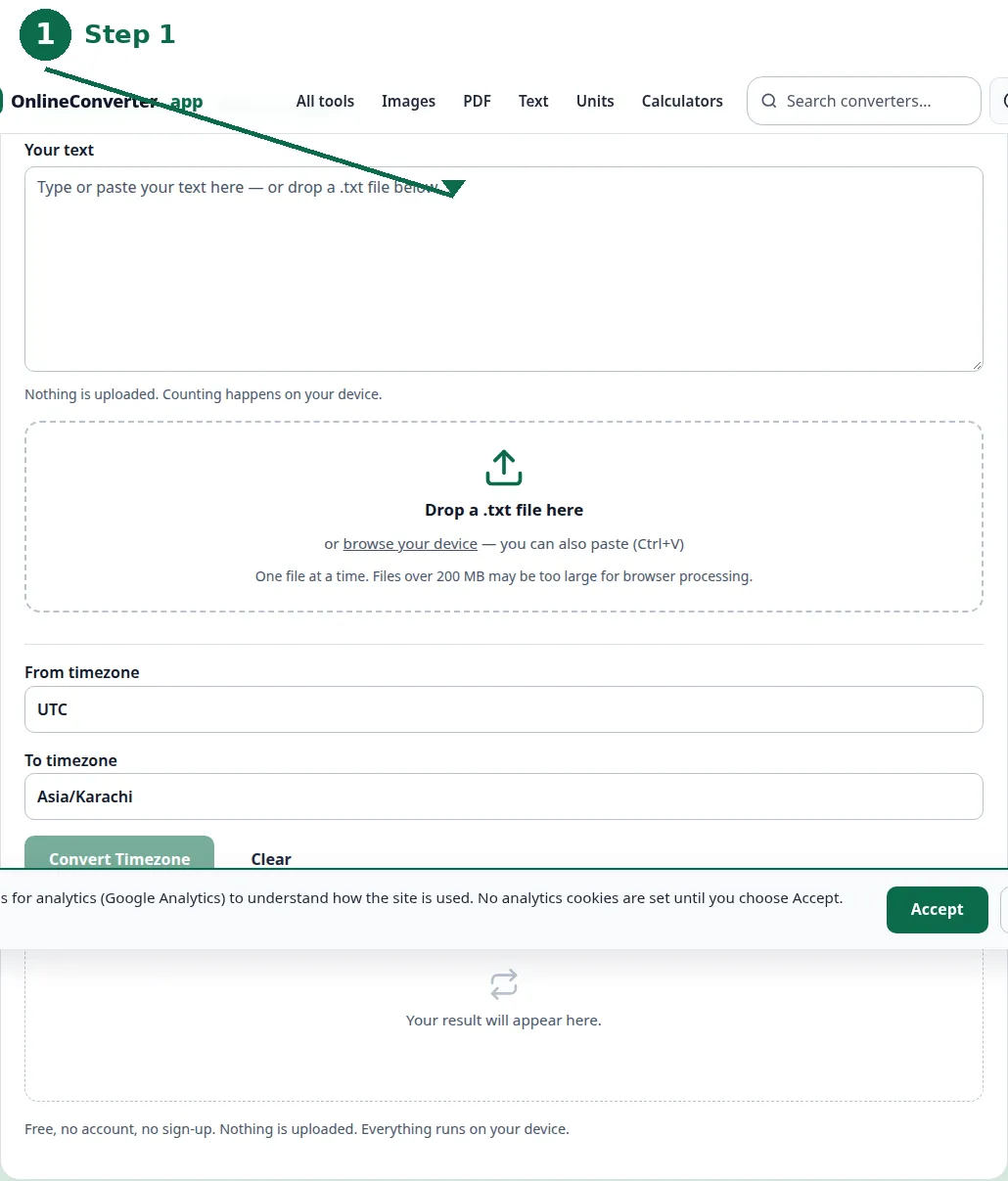
- Step 1 — Open the Timezone Converter and enter the time and the zone it is in.
- Step 2 — Pick the zone to convert to, and convert.
- Step 3 — Read the result — the time and the date in the new zone.
- Step 4 — Check the date as well as the time, and check whether either zone is on daylight saving.

The date moves too
Converting across the world can move the date as well as the time, and the date is the part people forget. It is 3pm on Monday in Karachi; in Tokyo, nine hours ahead in offset terms, it is 7pm on Monday; in New York, ten hours behind Karachi, it is 5am on Monday. But it is 11pm on Monday in Karachi, and in Tokyo it is 3am on Tuesday — the same moment, a different day.
The international date line is where the date jumps: crossing it westward moves the date forward a day, crossing it eastward moves it back. You do not need to track the line itself — the converter does that — but you do need to read the date in the result, not just the time. A meeting set for Tuesday in one zone can be Monday in another, and the invitation must carry the date for each zone, not just the time.
| City | Offset (winter) | When it is 3pm in Karachi |
|---|---|---|
| Karachi | UTC+5 | 3pm, same day |
| London | UTC+0 | 10am, same day |
| New York | UTC-5 | 5am, same day |
| Los Angeles | UTC-8 | 2am, same day |
| Tokyo | UTC+9 | 7pm, same day |
| Sydney | UTC+11 | 9pm, same day |

Daylight saving: the offset moves
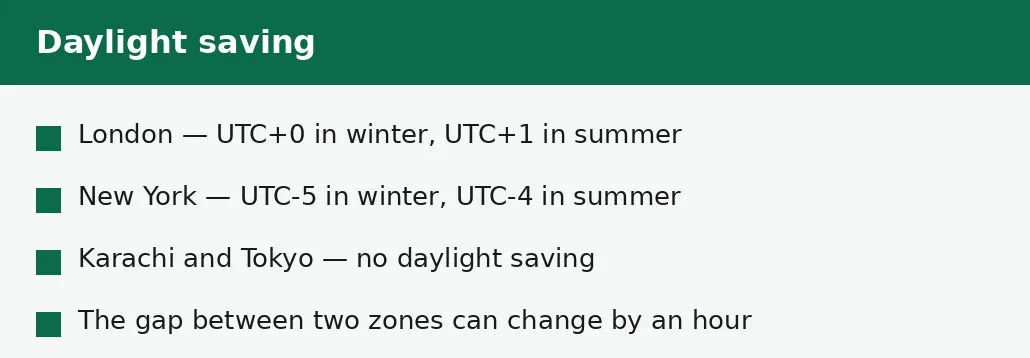
Daylight saving moves a zone's offset by an hour for part of the year: London is UTC+0 in winter and UTC+1 in summer, New York is UTC-5 in winter and UTC-4 in summer. The method does not change — go through UTC with the offset that applies on the day — but the offset does, and the gap between two zones can change with it: London and New York are 5 hours apart in winter and 4 hours apart in summer.
Not every zone observes daylight saving: Karachi and Tokyo do not, and many zones near the equator do not either, because their daylight barely changes through the year. And the changeover dates differ by country — the United States and Europe switch on different weekends — so for a few weeks a year the gap between two zones is neither its winter value nor its summer one. The converter knows the dates; the rule for you is to check whether each zone is on summer time on the day in question, and never to assume the offset from last month still holds.
The conversions people actually make
The most common conversions are for meetings, calls and flights: a team spread across Karachi, London and New York; a call with Tokyo; a flight that lands at a local time in another zone. For meetings, the courteous conversion is the one that shows the time in every zone, with the date, so nobody has to convert it themselves — and the meeting that is 3pm in Karachi is 10am in London and 5am in New York, which is a fact worth knowing before the invitation goes out.
For flights, the arrival time on the ticket is the local time at the destination, and the duration is the difference between the two local times plus the offset change — a flight that leaves at 10am and arrives at 4pm may have taken 11 hours, not 6, because the destination is 5 hours behind. The converter handles the arithmetic; the traveller's job is to read the date on arrival, which may be the same day or the next.
Troubleshooting
Why is my meeting on the wrong day for one person?
Because the date moved with the time: converting across the world can shift the day, and the invitation carried the time but not the date for that zone. Always state the date as well as the time, for every zone.
Why is the gap between two cities different from last month?
Daylight saving: one or both zones switched to summer time, moving the offset by an hour. The gap between London and New York is 5 hours in winter and 4 in summer — check the offset on the day, not from memory.
Why does UTC and GMT give me the same answer?
Because in everyday use they are the same time. UTC is the precise standard, GMT the older name; they differ by a fraction of a second, which no meeting, flight or call can notice.
Common questions
What is UTC?
Coordinated Universal Time — the reference clock the world sets its time zones by. Every time zone is UTC plus or minus a number of hours: Karachi is UTC+5, London is UTC+0 in winter, New York is UTC-5 in winter.
Is UTC the same as GMT?
In everyday use, yes. GMT is the older name for the time at Greenwich; UTC is the precise atomic-clock standard that replaced it. They differ by a fraction of a second, which no meeting or flight can notice.
How do I convert a time between time zones?
Go through UTC: subtract the first zone's offset to get UTC, then add the second zone's offset. And check the date as well as the time — converting across the world can move the day.
What time is it in New York when it is 3pm in Karachi?
5am the same day, in winter, when New York is UTC-5 and Karachi is UTC+5. In summer, when New York is on daylight saving at UTC-4, it is 6am.
Does daylight saving change the conversion?
It changes the offset, not the method: a zone on summer time is one hour ahead of its winter offset. Check whether each zone is on summer time on the day in question.
Why does the date change when I convert a time?
Because the zones are far apart in offset: late night in one zone is already tomorrow in a zone far to the east, and still yesterday in a zone far to the west. The converter shows the date — read it, not just the time.
Summary
UTC is the reference clock, and every time zone is UTC plus or minus some hours; GMT is the older name for the same idea. Convert through UTC — subtract the first offset, add the second — and always check the date as well as the time, because converting across the world can move the day. Daylight saving moves the offset by an hour, not the method, so check whether each zone is on summer time on the day in question.