BMI explained: what your number means
Last updated: 9 November 2026.
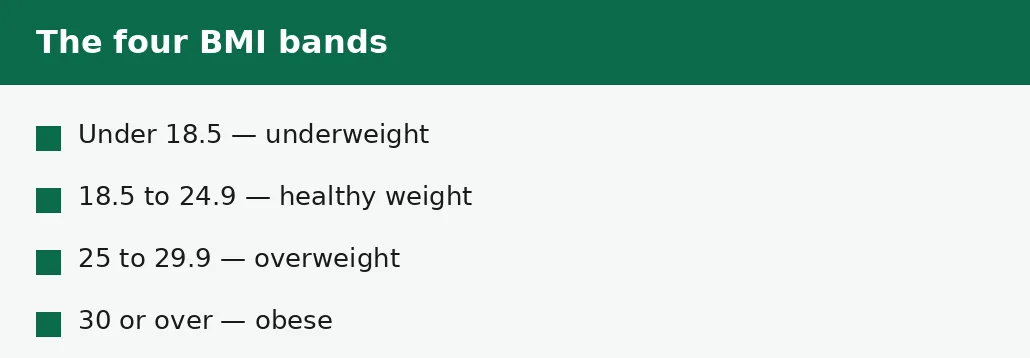
BMI — body mass index — is your weight in kilograms divided by your height in metres, squared. A person 1.75 metres tall weighing 70 kilograms has a BMI of 70 divided by 1.75 squared, which is 22.9. The standard bands are: under 18.5 underweight, 18.5 to 24.9 healthy weight, 25 to 29.9 overweight, and 30 or over obese. BMI is a screening number, not a diagnosis: it does not know muscle from fat, and it is only one piece of information about health. This guide explains the number; it is not medical advice, and a clinician is the person to talk to about what it means for you.
What BMI actually is
BMI was designed in the 1830s as a population measure — a way to compare the builds of large groups of people — and it is still used that way today: a quick, cheap screening number that puts a person's weight in the context of their height. It was never meant to judge one person's health on its own, and every serious guide to it says so, because a single number cannot know what a body is made of.
The idea behind it is simple: taller people weigh more, so weight alone says nothing, and weight compared with height says something. Dividing by height squared — rather than by height — adjusts for the fact that a taller body is bigger in three dimensions, not one. The result is a number that is roughly comparable between a person 1.60 metres tall and a person 1.90 metres tall, which a simple weight-to-height ratio would not be.
How to work out your BMI
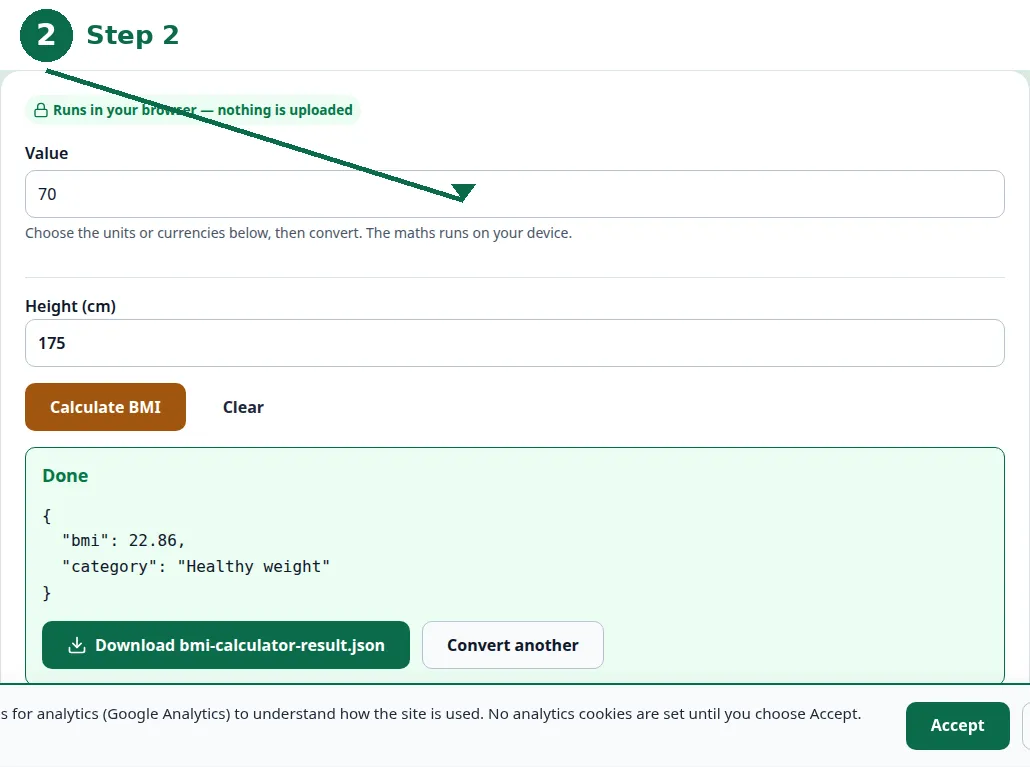
Take your weight in kilograms and your height in metres. Square the height — multiply it by itself — then divide the weight by that number. A person 1.75 metres tall weighing 70 kilograms: 1.75 squared is 3.0625, and 70 divided by 3.0625 is 22.9. That is the BMI, and it falls in the healthy-weight band.
If you know your height in centimetres, divide by 100 first: 175 centimetres is 1.75 metres. If you know your weight in pounds, convert it first — a pound is 0.4536 kilograms, so 154 pounds is about 70 kilograms — or use the kilograms and pounds guide to convert and then come back. The calculator does the squaring for you, but knowing the formula means you can check its answer.
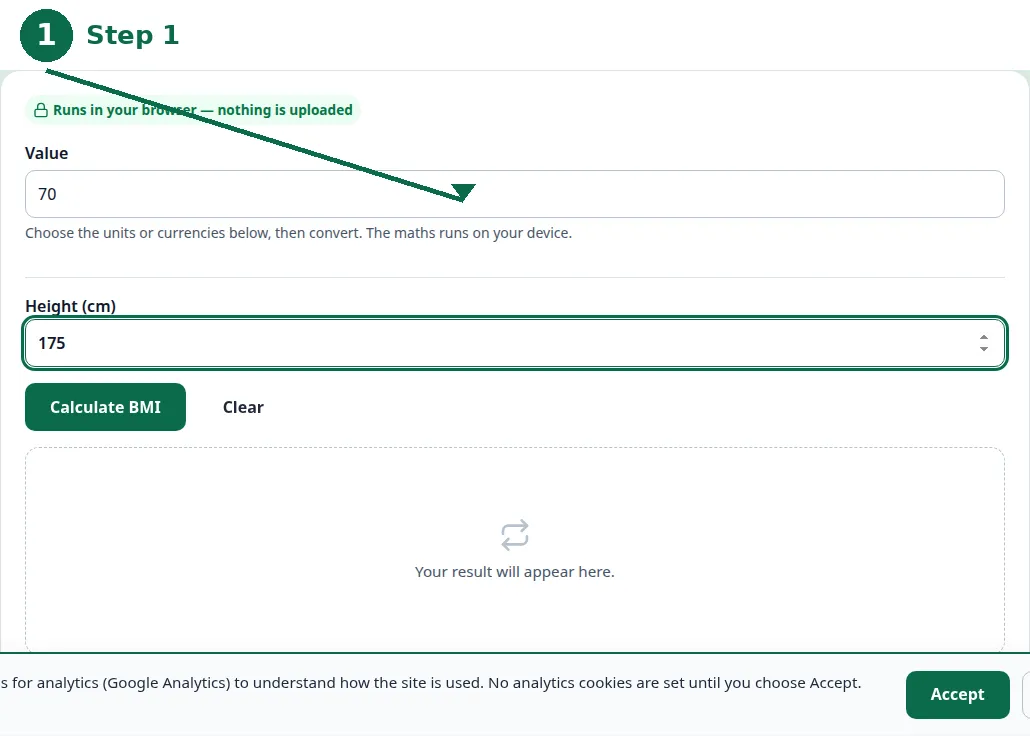
- Step 1 — Open the BMI Calculator and enter your weight.
- Step 2 — Enter your height in centimetres, and check the units match what you measured.
- Step 3 — Click Calculate and read your BMI and its band.
- Step 4 — Read the limits below before you act on the number — BMI is a screening number, not a diagnosis.
The bands, and what they mean
Under 18.5 is underweight: the number says the weight is low for the height, which can mean too little muscle or fat, or an underlying health issue worth checking. From 18.5 to 24.9 is the healthy-weight band, where the large population studies find the lowest risk of weight-related disease. From 25 to 29.9 is overweight, and 30 or over is obese — bands where the risk of type 2 diabetes, heart disease and joint problems rises, on average, across populations.
On average is doing a lot of work in that sentence. The bands describe risk across thousands of people, not the fate of one person: a BMI of 26 in a fit, muscular person means something different from a BMI of 26 in a sedentary one, and a BMI of 24 does not guarantee health any more than a BMI of 31 guarantees disease. The bands are a prompt to look closer, not a verdict.
| BMI | Band | What it means |
|---|---|---|
| Under 18.5 | Underweight | Weight low for height — worth checking. |
| 18.5 to 24.9 | Healthy weight | Lowest average risk in population studies. |
| 25 to 29.9 | Overweight | Above average risk — look closer. |
| 30 or over | Obese | Higher average risk — talk to a clinician. |
| Any band | One number only | Never a diagnosis on its own. |
What BMI gets wrong
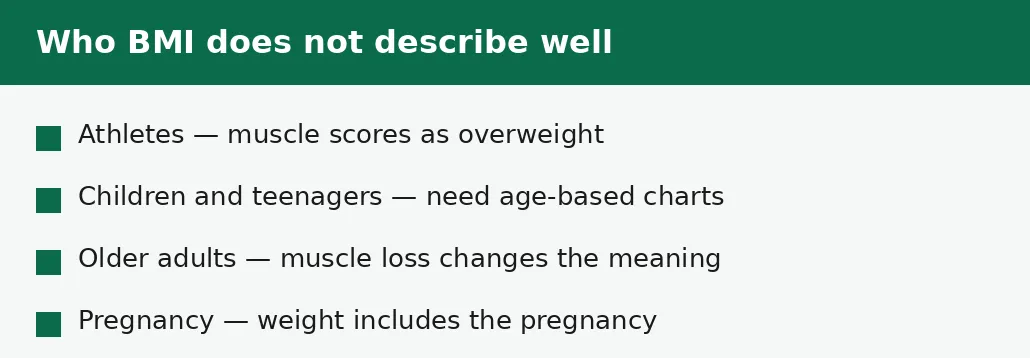
BMI cannot tell muscle from fat, and muscle is heavy: a rugby player or a weightlifter can score as overweight or even obese while carrying very little body fat. The same blindness works the other way — an older person who has lost muscle can score in the healthy band while carrying a high proportion of fat. In both cases the number is misleading, and a waist measurement or a body-fat estimate tells the truer story.
BMI also does not fit everybody the same way. Children and teenagers need age-and-sex charts, not adult bands, because they are still growing. Pregnancy changes weight for reasons that have nothing to do with fat. And the bands were drawn mostly from European populations — people of South Asian, African and East Asian backgrounds carry health risks at lower BMIs on average, and several health authorities use lower thresholds for them. A number without that context is a number half-understood.
What to do with your number
If your BMI falls in the healthy band and you feel well, there is nothing to do except keep doing what keeps you there. If it falls outside the band, the useful next step is not panic but a second measure: a waist measurement — over 94 cm for men and 80 cm for women is the usual flag — a blood-pressure check, or a conversation with a clinician who can put the number beside your history, your activity and your family background.
What BMI is genuinely good for is tracking change over time in the same person: the same scales, the same height, measured the same way, month by month. A BMI drifting down from 31 toward 29 is real progress, whatever band it sits in today, and a BMI creeping up year by year is worth noticing early, while it is easy to reverse. The number is a compass, not a judge.
The mistakes people make with BMI
The most common mistake is treating BMI as a diagnosis: a single number deciding whether someone is healthy or not. It is a screening tool, and screening tools flag things for a closer look — they do not conclude them. The second mistake is measuring wrong: height in shoes, weight after a meal, or guessing either number, and then trusting the result to a decimal place it never had.
The third mistake is chasing the number instead of the health behind it: crash dieting to reach a band, or ignoring a high waist measurement because the BMI looks fine. The bands are a guide to risk, not a target to hit at any cost — and any plan to change your weight is worth discussing with a clinician first.
Troubleshooting
Why is my BMI different on different calculators?
The formula is the same everywhere, so a different result means different inputs — usually height in centimetres entered as metres, or weight in pounds entered as kilograms. Check the units, then check the numbers.
Why does my BMI say overweight when I am fit?
BMI cannot tell muscle from fat, and muscle is heavy. Athletes and muscular people often score as overweight. A waist measurement or body-fat estimate describes your build far better than BMI alone.
Why does my BMI keep changing?
Weight changes through the day — food, water, clothing — so weigh yourself at the same time, in the same conditions, to compare like with like. A single reading is a snapshot; a trend over weeks is the signal.
Common questions
What is a healthy BMI?
18.5 to 24.9 is the healthy-weight band in the standard scale. It describes average risk across populations, not a guarantee for any one person.
How is BMI calculated?
Weight in kilograms divided by height in metres, squared. A person 1.75 metres tall weighing 70 kilograms has a BMI of 70 divided by 3.0625, which is 22.9.
Is BMI accurate?
As a population screening number, yes. As a verdict on one person, no — it cannot tell muscle from fat, and it fits some groups worse than others. It is one piece of information, not a diagnosis.
Does BMI work for children?
Not with adult bands. Children and teenagers need age-and-sex charts, because they are still growing. A paediatrician or school nurse uses those charts, not this scale.
What is a good BMI for my age?
The standard bands do not change with age, but their meaning does: older adults naturally carry less muscle, so the same BMI can mean a higher fat proportion. A clinician reads the number in context.
Is this medical advice?
No. This guide explains what the number is and how it is worked out. What it means for you is a question for a clinician, who can put it beside your history and your health.
Summary
BMI is weight in kilograms divided by height in metres, squared — 22.9 for a 1.75-metre, 70-kilogram person. The bands run from under 18.5 (underweight) through 18.5 to 24.9 (healthy) to 30 or over (obese). It is a screening number, not a diagnosis: it cannot tell muscle from fat, and it fits some people worse than others. Use it to track change, and talk to a clinician about what it means for you.