How to work out a tip
Last updated: 9 November 2026.

A tip is a percentage of the bill before tax: 15 percent of an 80 bill is 12, so the total is 92. In the United States 15 to 20 percent is the usual range for table service — 15 percent for good service, 20 percent for great service — while in much of Europe a tip is smaller or already included, and in Japan and China tipping is not expected at all. The maths is the same everywhere: multiply the bill by the tip percentage and divide by 100, add it to the bill, and split the total by the number of people if the bill is shared.
What a tip is, and when one is expected
A tip is a voluntary payment for service, added to the bill and usually given as a percentage of it. In the United States it is effectively part of the price: servers are often paid below the standard minimum wage on the assumption that tips make up the difference, so 15 to 20 percent for table service is expected rather than generous. In much of Europe, service is often included in the price or in the wages, and a small tip — rounding up, or 5 to 10 percent — is a thank-you rather than an obligation.
In Japan and China, tipping is not part of the culture at all, and offering one can confuse or even offend. In the Middle East and South Asia, practices vary by place and by establishment. The honest rule is to check the local custom before you travel — and to check the bill before you tip, because a service charge already added is the tip, and tipping on top of it means paying twice.
How to work out a tip
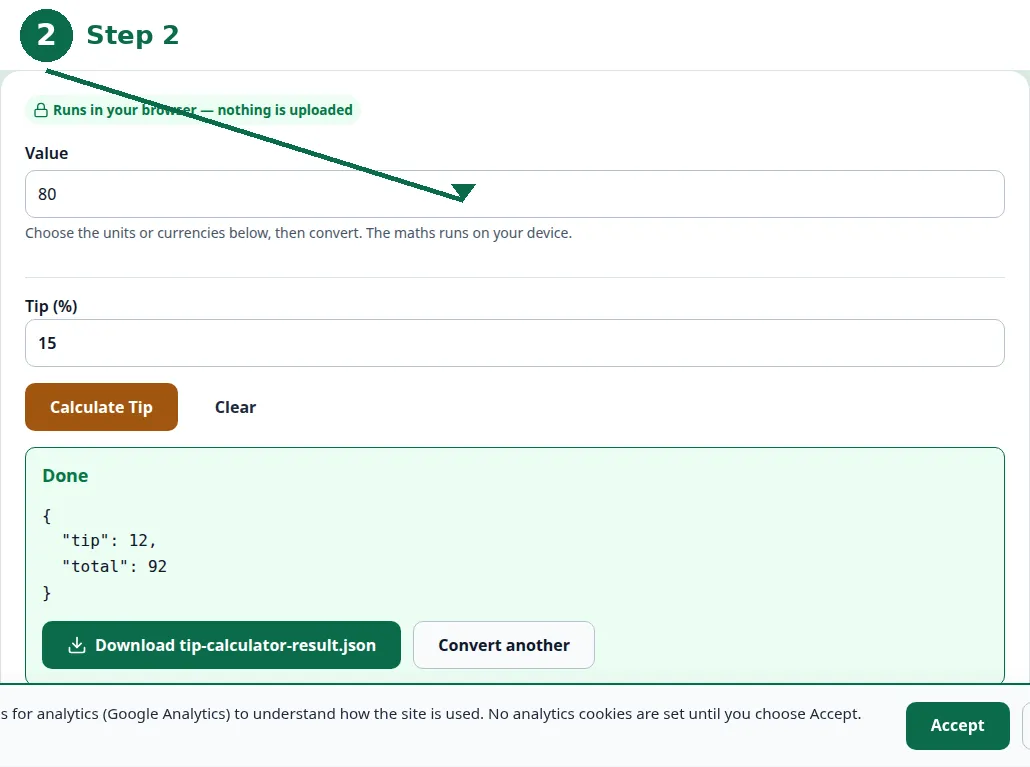
Multiply the bill by the tip percentage and divide by 100, then add the tip to the bill. An 80 bill at 15 percent: 80 times 15 is 1200, divided by 100 is 12, so the tip is 12 and the total is 92. At 20 percent the tip is 16 and the total is 96. The bill to use is the bill before tax in the United States, where tax is added separately — tipping on the tax means tipping on money that was never service.
If the bill already includes a service charge, that is the tip: read the bill before you add anything. And if the service was poor, the tip is still usually given — a smaller one — because in the United States it is part of the server's pay, not only a reward.
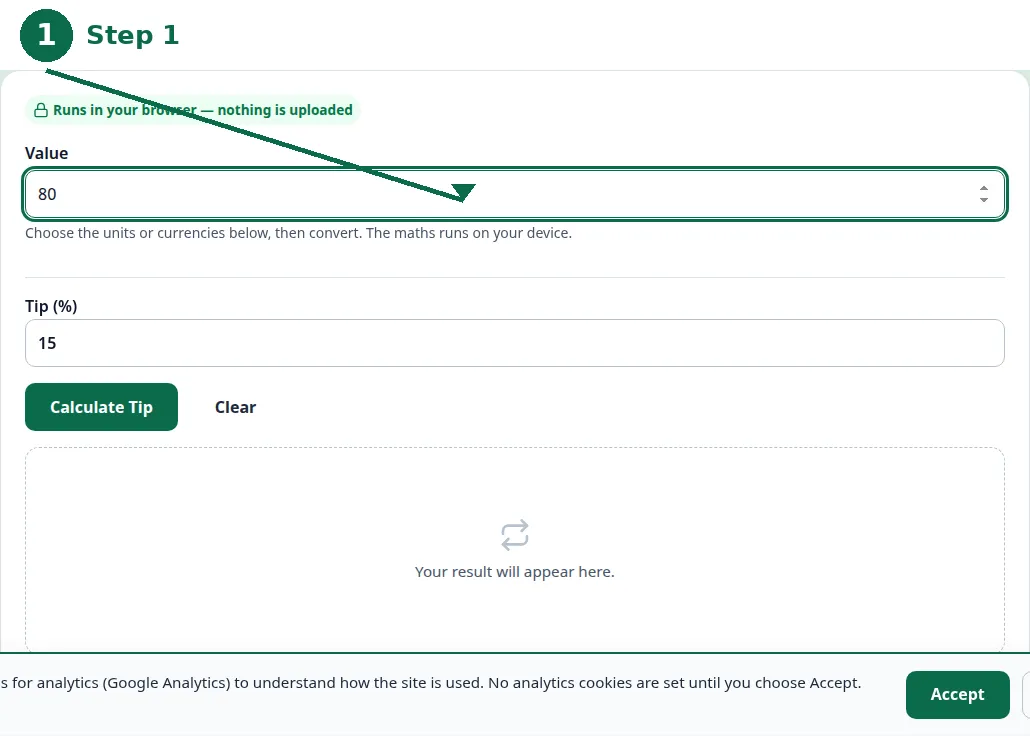
- Step 1 — Open the Tip Calculator and enter the bill, before tax.
- Step 2 — Set the tip percentage: 15 for good service, 20 for great service.
- Step 3 — Click Calculate and read the tip and the total.
- Step 4 — If the bill is shared, divide the total by the number of people — not the tip alone.
How much to tip
Fifteen percent is the baseline for good table service in the United States: the food arrived hot, the drinks were refilled, nothing went wrong. Twenty percent is for great service — the server noticed what you needed before you asked, handled a problem well, or made the evening better. Ten percent is the floor for service that was poor but not disastrous, and below that is a message rather than a tip.
For other services the numbers are smaller and looser: a few dollars for a taxi driver who helped with bags, a dollar or two per drink at a bar, 10 to 15 percent for a haircut, a dollar per bag for a hotel porter. None of these are rules written anywhere — they are customs, and customs vary by city as well as by country — so when in doubt, ask a local, or match what the people around you are doing.
| Situation | Usual tip | Notes |
|---|---|---|
| Table service, US — good | 15% | The baseline for good service. |
| Table service, US — great | 20% | For service that made the evening better. |
| Table service, Europe | 5-10% or round up | Often service is already included. |
| Bar, per drink | 1-2 dollars | Or 15-20% of the tab. |
| Taxi | 10-15% | More if bags were carried. |
| Haircut | 10-15% | On the price before products. |
| Japan, China | None | Tipping is not expected. |
The quick mental maths
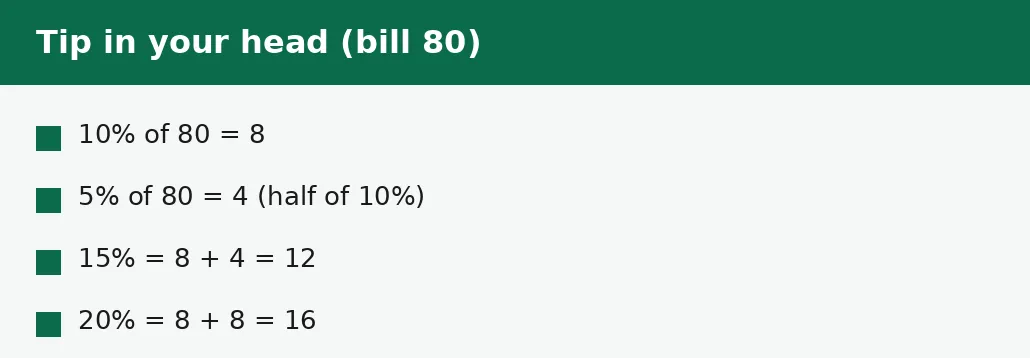
Ten percent of any bill is the bill with the decimal point moved one place left: 10 percent of 80 is 8, of 47.50 is 4.75. Five percent is half of ten percent: 4 on an 80 bill. So 15 percent is ten plus five — 8 plus 4 is 12 — and 20 percent is ten percent twice — 8 plus 8 is 16. With those two anchors you can tip any bill in seconds, without a calculator, and without the embarrassment of working it out on your phone at the table.
For an awkward bill, round it first: 10 percent of 47.50 is 4.75, and 15 percent is about 7.10 — close enough to 7 that nobody will mind, and easier than chasing the pennies. Tipping is a gesture, not an audit, and a rounded number given promptly beats an exact number given after long arithmetic.
Splitting the bill fairly
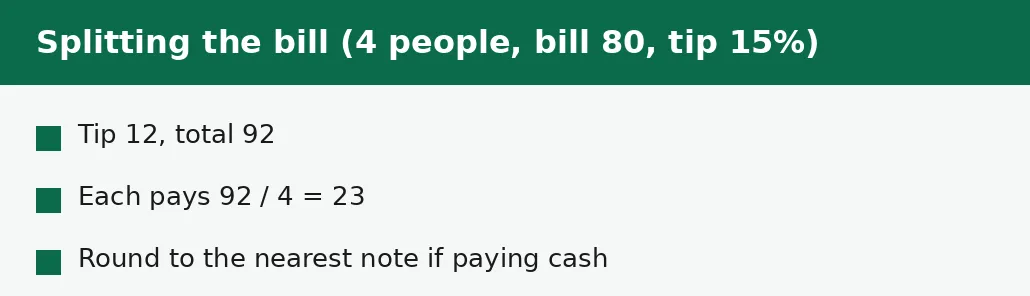
Split the total, not the tip: add the tip to the bill first, then divide by the number of people. Four people, an 80 bill, 15 percent tip: the tip is 12, the total is 92, and each person pays 23. Splitting the tip separately and the bill separately gives the same answer with more arithmetic and more chances to go wrong.
When people ordered very different things, the fair split is each person's share plus their share of the tip: if you ordered 20 of the 80, your share of the bill is 20 and your share of the 12 tip is 3, so you pay 23 — which, in this case, is the same as the even split, because your share was a quarter of the bill. When the shares are uneven, work them out per person rather than splitting evenly and resenting it. And when paying cash, round each share to the nearest note and let the rounding absorb the coins.
The mistakes that cost money
The most common mistake is tipping on the total including tax, or on a bill that already includes a service charge. Read the bill first: if it says service included, the tip is already there, and adding 15 percent on top means paying twice. The second mistake is tipping on the wrong base — the full bill when only part of it was service, or the bill after a discount that was never charged.
The third mistake is the arithmetic slip: 15 percent of 80 is 12, not 15, and 20 percent of 47.50 is 9.50, not 20. The mental anchors — ten percent first, then build — catch those slips, because 10 percent of 80 is obviously 8, and anything far from that is obviously wrong.
Troubleshooting
Why is my tip bigger than I expected?
Check whether you tipped on the total including tax, or on a bill that already included a service charge. The tip is a percentage of the bill before tax, and a service charge already added is the tip.
Why does the split never come out even?
Because bills rarely divide evenly. Split the total — bill plus tip — by the number of people, and round each share to the nearest note when paying cash. The rounding absorbs the difference.
Should I tip if the service was bad?
In the United States, usually yes — a smaller tip, because the tip is part of the server's pay, not only a reward. If the service was truly unacceptable, speak to the manager instead of leaving nothing.
Common questions
How much should I tip at a restaurant?
15 to 20 percent of the bill before tax in the United States — 15 percent for good service, 20 percent for great service. In much of Europe, 5 to 10 percent or rounding up is usual, and the bill often already includes service.
How do I calculate 15% of a bill?
Multiply the bill by 15 and divide by 100. For an 80 bill that is 12. Or work it out in your head: 10 percent is 8, 5 percent is 4, and 15 percent is 8 plus 4, which is 12.
Do I tip on the total including tax?
No — tip on the bill before tax, where tax is added separately. Tipping on the tax means tipping on money that was never service.
How do I split a bill between friends?
Add the tip to the bill first, then divide the total by the number of people. Four people sharing an 80 bill with a 12 tip pay 23 each.
Do I need to tip in Europe?
It depends on the country and the bill. Service is often included in the price, in which case a small tip or rounding up is a thank-you, not an obligation. Check the bill first.
What if the bill already includes a service charge?
Then the tip is already paid. Do not add another one on top — check the bill for the words service included or service charge before you tip.
Summary
A tip is a percentage of the bill before tax: 15 percent of 80 is 12, total 92. Fifteen to twenty percent is the usual range for table service in the United States; in Europe it is smaller or included, and in Japan it is not expected. Work out 10 percent first and build from it, split the total rather than the tip, and always read the bill for a service charge before you add anything.