How to calculate a percentage, step by step
Last updated: 9 November 2026.
A percentage is a part out of a hundred: 25 percent means 25 out of every 100. To find a percentage of a number, multiply the number by the percentage and divide by 100 — 25 percent of 80 is 80 times 25 divided by 100, which is 20. To find what percentage one number is of another, divide the first by the second and multiply by 100 — 20 out of 80 is 20 divided by 80 times 100, which is 25 percent. Those two moves cover nearly every percentage question you will meet, including discounts, tips, marks and price rises.
What a percentage actually is
Percent means per hundred, and a percentage is simply a way of saying how big one thing is compared with another, scaled so the comparison is always out of 100. Saying a battery is at 25 percent means it holds 25 units of charge out of the 100 it holds when full. Saying 25 percent of the class passed means 25 out of every 100 pupils passed — and if the class has 80 pupils, that is 20 of them.
The scaling is the whole point: percentages let you compare things of different sizes on the same footing. A shop that sells 20 out of 80 items and a shop that sells 30 out of 120 items have both sold 25 percent of their stock, even though the numbers of items are different. Without percentages you would be comparing 20 with 30 and drawing the wrong conclusion; with them, the comparison is honest.
How to calculate a percentage
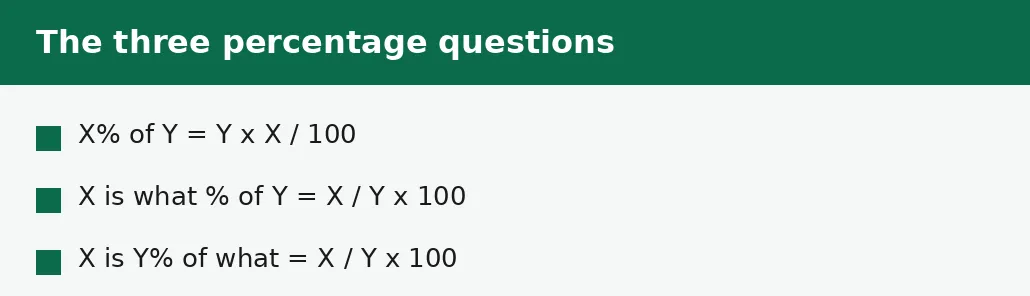
Nearly every percentage question is one of three shapes, and each has one formula. The first shape is finding a percentage of a number: what is 25 percent of 80? Multiply the number by the percentage and divide by 100 — 80 times 25 is 2000, divided by 100 is 20. The second shape is finding what percentage one number is of another: 20 is what percent of 80? Divide the first by the second and multiply by 100 — 20 divided by 80 is 0.25, times 100 is 25 percent.
The third shape is the reverse: 20 is 25 percent of what number? Divide the part by the percentage and multiply by 100 — 20 divided by 25 is 0.8, times 100 is 80. If you can do those three, you can do discounts, tips, exam marks, price rises and interest — they are all the same three questions wearing different clothes.
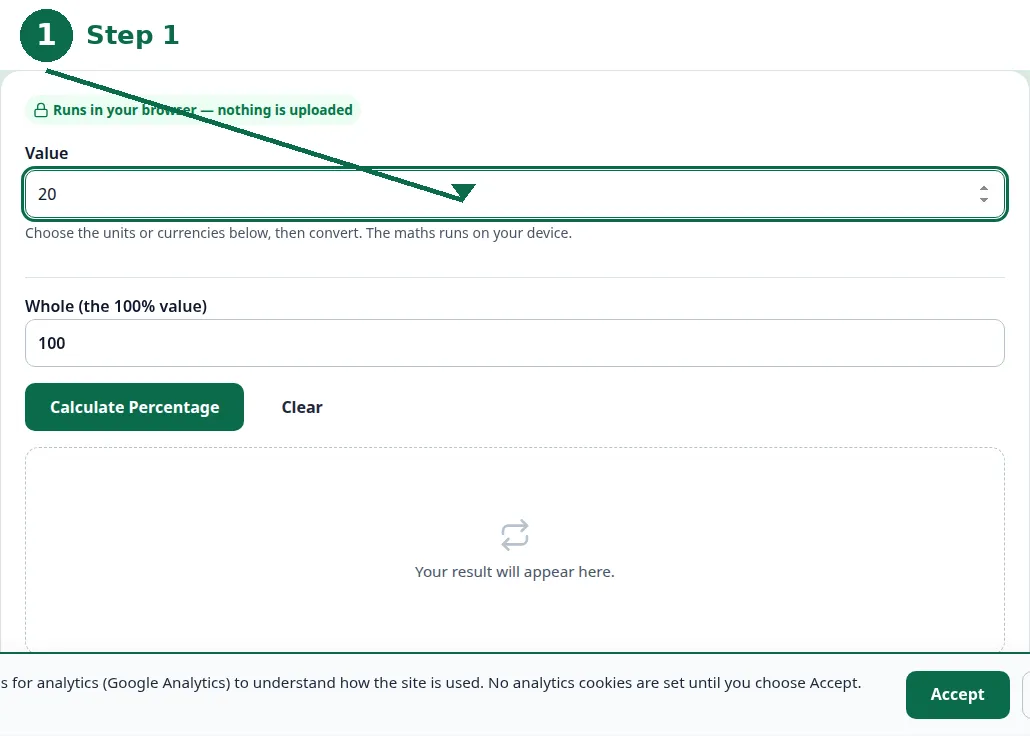
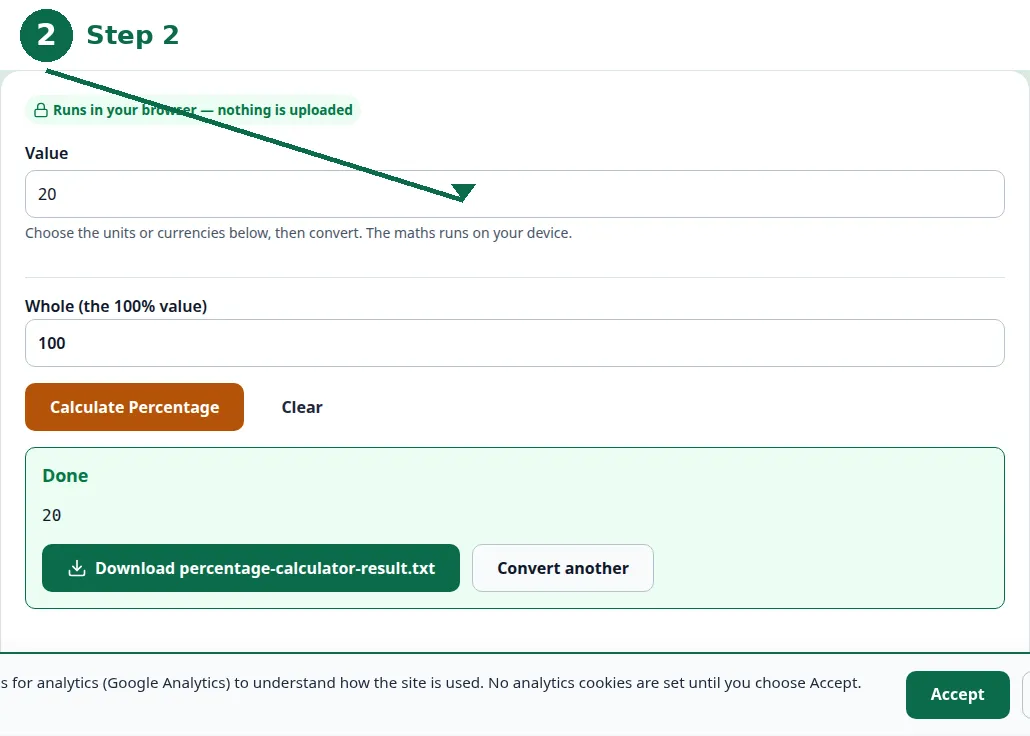
- Step 1 — Open the Percentage Calculator and enter the number the percentage is taken from.
- Step 2 — Enter the percentage, and check the whole is the number you meant — 100 is the default.
- Step 3 — Click Calculate and read the result — and the working, so you can check it.
- Step 4 — Sanity-check the answer: a percentage of a number is always smaller than the number itself, unless the percentage is over 100.
The three questions, worked in full
Question one: what is 15 percent of 240? Multiply 240 by 15 to get 3600, then divide by 100 to get 36. That is the answer — 15 percent of 240 is 36 — and it is also the tip on a 240 bill at 15 percent, and the discount on a 240 item at 15 percent off. One calculation, three everyday uses.
Question two: 36 is what percent of 240? Divide 36 by 240 to get 0.15, then multiply by 100 to get 15 percent. This is the exam-marks question — 36 marks out of 240 is 15 percent — and the survey question, and the progress question. Question three: 36 is 15 percent of what? Divide 36 by 15 to get 2.4, then multiply by 100 to get 240. This is the backwards question, and it is the one people get wrong most often, because the instinct is to multiply when the correct move is to divide.
| Question | Example | Working | Answer |
|---|---|---|---|
| What is X% of Y? | What is 15% of 240? | 240 x 15 / 100 | 36 |
| X is what % of Y? | 36 is what % of 240? | 36 / 240 x 100 | 15% |
| X is Y% of what? | 36 is 15% of what? | 36 / 15 x 100 | 240 |
| What is 20% off 250? | Discount price | 250 x 0.8 | 200 |
| 80 rose to 100: what % rise? | Percentage increase | (100 - 80) / 80 x 100 | 25% |
Discounts, tips and rises: the everyday uses
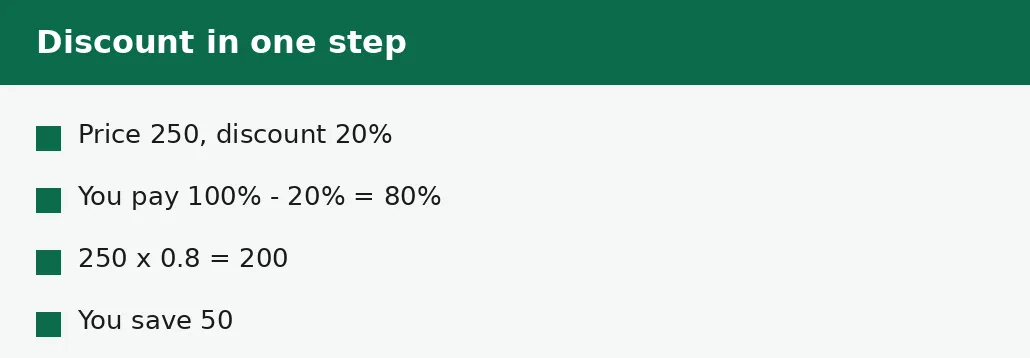
A discount is the first question with one extra step. A 250 item at 20 percent off: the discount is 20 percent of 250, which is 50, so you pay 200. Or skip the middle step and multiply by what remains: 100 percent minus 20 percent is 80 percent, and 250 times 0.8 is 200. The second way is faster and less error-prone, and it is the one to learn by heart.
A percentage rise or fall is the second question, with the starting number as the base — always. A price that rises from 80 to 100 has risen by 20, and 20 out of 80 is 25 percent, so the rise is 25 percent. The same 20 rise from 200 to 220 is a 10 percent rise, because the base is bigger. The base is the number you started from, never the number you ended at, and getting the base wrong is the single most common percentage error there is.
Quick mental tricks
Ten percent of any number is the number with the last digit dropped: 10 percent of 240 is 24. Five percent is half of that: 12. Twenty percent is twice ten percent: 48. Twenty-five percent is a quarter: 60. With those four anchors — 10, 5, 20 and 25 — you can build most everyday percentages in your head: 15 percent is 10 plus 5, which is 24 plus 12, which is 36; 30 percent is three times 10 percent, which is 72.
For anything else, the calculator is the honest tool: type the numbers in, read the working, and check the answer against a rough estimate. A 17 percent tip on a 240 bill should be near 40 — ten percent is 24, five percent is 12, two percent is about 5, and 24 plus 12 plus 5 is 41 — and if the calculator says 408, a decimal point has slipped somewhere.
The mistakes to avoid
The most common mistake is using the wrong base: working out a rise from 80 to 100 as 20 percent, because 20 out of 100 is 20 percent — but the base is 80, the starting number, and the rise is 25 percent. Always ask what the percentage is of, before you calculate anything.
The second mistake is adding percentages that have different bases: a price that rises 10 percent and then falls 10 percent does not return to where it started, because the fall is 10 percent of the bigger number. A 100 item rises to 110, then falls 10 percent of 110 — 11 — to 99. And the third mistake is confusing percentage points with percent: a rate rising from 10 percent to 12 percent has risen by 2 percentage points, which is a 20 percent rise in the rate itself.
Troubleshooting
Why is my answer bigger than the number I started with?
A percentage of a number is smaller than the number — unless the percentage is over 100. If 20 percent of 80 came out as 160, the multiplication and division are the wrong way round: multiply by the percentage, then divide by 100.
Why does a 10% rise then a 10% fall not return to the start?
The two percentages have different bases. A 100 item rises 10 percent to 110, then falls 10 percent of 110 — 11 — to 99. Percentages with different bases cannot be added or cancelled directly.
Why is my discount price wrong?
Check whether you subtracted the discount or multiplied by what remains. A 20 percent discount on 250 means you pay 80 percent: 250 times 0.8 is 200. Subtracting 20 from 250 gives 230, which is a 20-unit discount, not a 20 percent one.
Common questions
How do I calculate a percentage of a number?
Multiply the number by the percentage and divide by 100. 25 percent of 80 is 80 times 25 divided by 100, which is 20.
How do I find what percentage one number is of another?
Divide the first number by the second and multiply by 100. 20 out of 80 is 20 divided by 80 times 100, which is 25 percent.
How do I calculate a percentage increase?
Subtract the old number from the new one, divide by the old number, and multiply by 100. A rise from 80 to 100 is 20 divided by 80 times 100, which is a 25 percent increase.
What is 20 percent off 250?
200. The discount is 50, so you pay 200 — or multiply by what remains: 250 times 0.8 is 200.
What is the difference between percent and percentage points?
A rate rising from 10 percent to 12 percent has risen by 2 percentage points — and by 20 percent of its original value. Percentage points are the simple difference; percent is the relative change.
How do I calculate a percentage in my head?
Use 10 percent as the anchor: move the decimal point one place left. 10 percent of 240 is 24, 5 percent is half of that (12), and 20 percent is double (48). Build other percentages from those.
Summary
A percentage is a part out of a hundred. To find X percent of a number, multiply by X and divide by 100; to find what percent one number is of another, divide and multiply by 100; to reverse the question, divide the part by the percentage and multiply by 100. The base is always the starting number — get that right and the rest follows.