Currency conversion explained: mid-market rates, fees and the true cost of converting
Last updated: 8 November 2026.
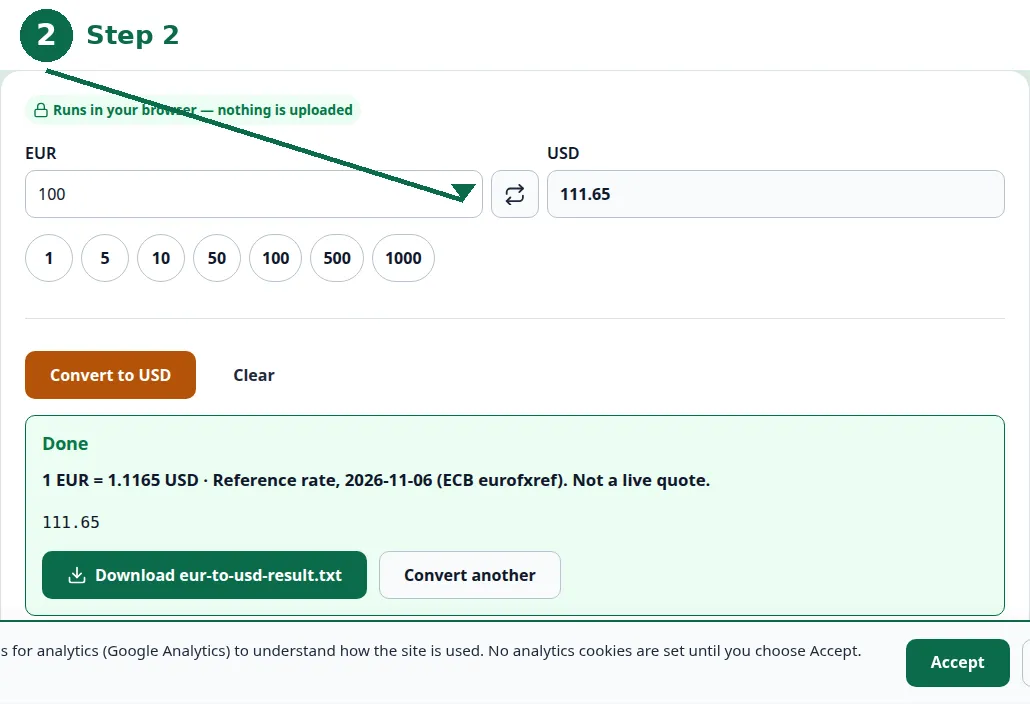
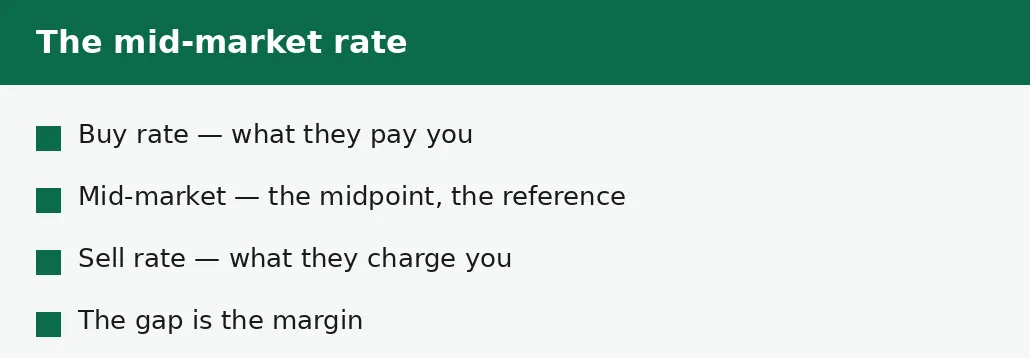
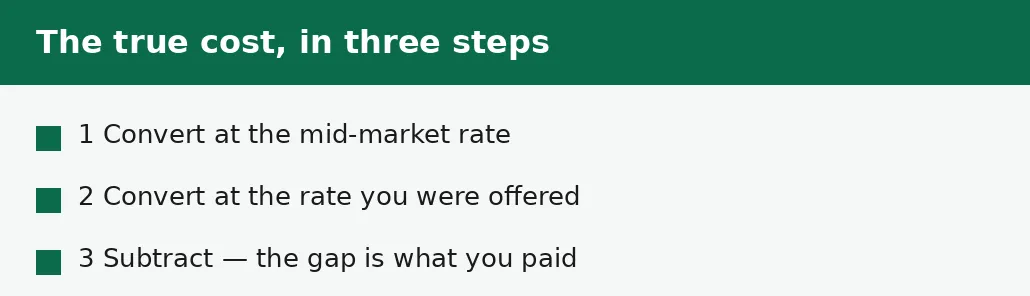
The mid-market rate is the rate banks use with each other — the midpoint between buying and selling — and it is the rate you see quoted in the news. It is not the rate you get: the rate a bank, a card or an exchange service actually gives you is the mid-market rate plus their margin, plus any flat fee, and the difference between the two is the true cost of converting. To work out what a conversion really costs, convert the amount at the mid-market rate, convert it at the rate you were actually offered, and subtract: the gap is what you paid for the conversion, whether or not anyone called it a fee.
The mid-market rate: what it is and what it is not
The mid-market rate is the midpoint between the rate at which a currency is bought and the rate at which it is sold, on the wholesale market where banks trade with each other. It is the rate quoted in the news, on search results and on currency sites — including this one, whose converter shows the reference rate from the European Central Bank for most pairs, and from the State Bank of Pakistan where rupees, dirhams or riyals are involved.
What it is not is a price you can buy at. No bank, card or exchange service sells you currency at the mid-market rate, because the margin between the mid-market rate and the rate they offer is how they are paid. Treating the mid-market rate as the rate you will get is the single most common mistake in currency conversion — and it is why a conversion that looked cheap on a search result turns out expensive at the till.
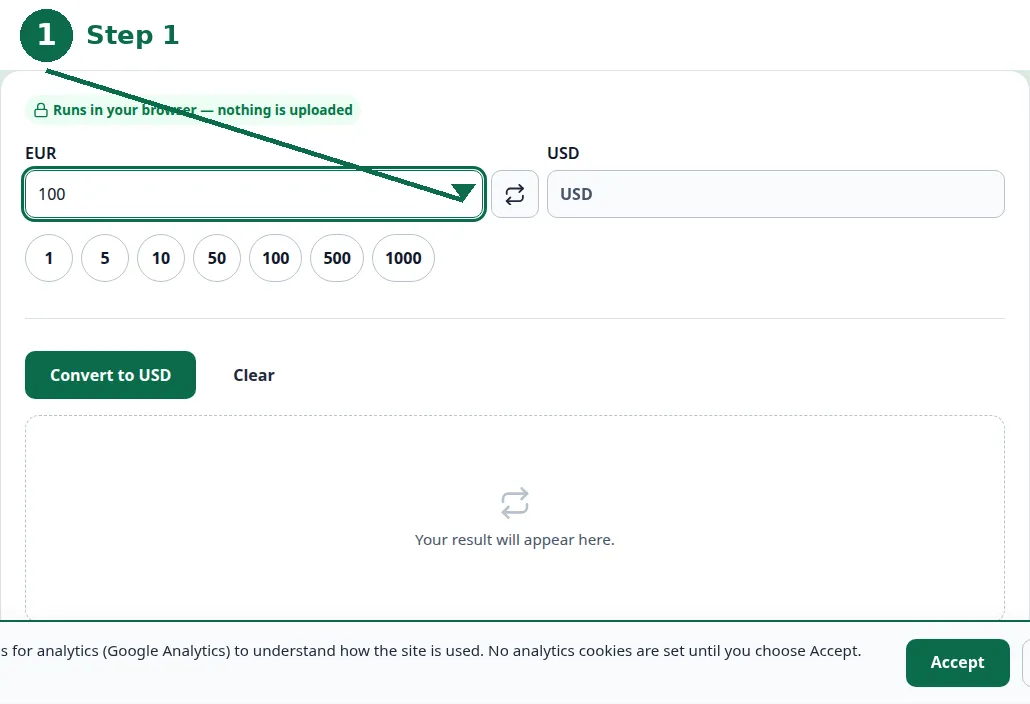
- Step 1 — Open the EUR to USD converter and enter the amount.
- Step 2 — Read the result at the reference rate, and note the rate and its date.
- Step 3 — Compare that result with the rate your bank, card or exchange service actually offers.
- Step 4 — Subtract: the gap between the two results is the true cost of the conversion.
The true cost: a worked example
Take a simple example with round numbers, so the arithmetic is visible. Suppose the mid-market rate is 1 euro = 1.08 dollars, and you want to convert 100 euros. At the mid-market rate, 100 euros is 108 dollars. Now suppose your provider offers 1 euro = 1.05 dollars: the same 100 euros becomes 105 dollars. The gap is 3 dollars — that is the true cost of this conversion, whether or not anyone called it a fee.
The same arithmetic works at any size: convert the amount at the mid-market rate, convert it at the offered rate, and subtract. A provider that advertises zero fees but offers a poor rate is charging you through the rate, and a provider that charges a flat fee but offers a rate close to mid-market may be cheaper overall. The only number that matters is the amount that arrives — and the gap is how you find it.
| Amount | At mid-market (1.08) | At offered rate (1.05) | True cost |
|---|---|---|---|
| 100 EUR | 108.00 USD | 105.00 USD | 3.00 USD |
| 500 EUR | 540.00 USD | 525.00 USD | 15.00 USD |
| 1,000 EUR | 1,080.00 USD | 1,050.00 USD | 30.00 USD |
| 5,000 EUR | 5,400.00 USD | 5,250.00 USD | 150.00 USD |
Where the fees hide
Fees hide in three places. The first is the rate itself: the margin between the mid-market rate and the offered rate, which is a fee by another name and the largest cost on most conversions. The second is the flat fee: a fixed charge per conversion, which matters most on small amounts — a 5-dollar fee on a 50-dollar conversion is 10 percent, and the same fee on a 5,000-dollar conversion is a tenth of a percent.
The third is the double conversion: converting through an intermediate currency — for example, rupees to dollars to euros — pays the margin twice, once on each leg. A direct conversion, where one exists, pays it once. And there are smaller hiding places too: a card that charges a foreign-transaction fee on top of its rate, an ATM that offers its own conversion at the machine, a service that rounds the rate against you. The defence against all of them is the same subtraction: mid-market result minus offered result.
Rates move: check the date
Exchange rates move every day, and sometimes sharply within a day, so a conversion checked yesterday is not today's conversion. The converter on this site shows the reference rate with its date — the European Central Bank publishes its reference rates daily, and the State Bank of Pakistan snapshot is likewise dated — and the date matters as much as the number, because a rate without a date is a guess about the past.
For a large conversion, the day matters too: a rate that moves 1 percent on 5,000 euros is 50 euros, which is more than most flat fees. There is no reliable way to predict the move — anyone who claims to know tomorrow's rate is guessing — but there is a reliable way to avoid the worst of it: compare the offered rate with the mid-market rate on the day, and do not convert on a day when the gap is unusually wide.
Checking a conversion before you commit
Three checks before a conversion goes through. First, the rate: what rate is actually being offered, and how far is it from the mid-market rate today? Second, the fees: is there a flat fee, a foreign-transaction fee, or a second conversion hidden in the route? Third, the amount that arrives: the provider should state it plainly, and if the amount that arrives is less than the mid-market conversion by more than you expected, the gap is the cost — ask what it is made of.
For a small conversion — a coffee abroad, a small online purchase — the gap is small money, and the cheapest option is usually the one you already have. For a large conversion — a fee payment, a transfer home, a purchase — the gap is real money, and ten minutes comparing the offered rate with the mid-market rate is the best-paid ten minutes of the transaction.
Troubleshooting
Why did I get less than the rate I saw online?
The rate online was the mid-market rate — a reference, not a price you can buy at. Your provider's rate includes their margin, and the gap between the two results is the true cost. Compare the offered rate with the mid-market rate before you convert.
Why does a zero-fee conversion still cost me?
Because the fee is in the rate, not in a separate charge. A provider that advertises zero fees but offers a poor rate is charging you through the margin — work out the gap, and you will see the cost.
Why did the same conversion cost more this week than last?
Rates move daily, and the margin can move too. A conversion checked last week is not this week's conversion — check the rate and its date on the day you convert.
Common questions
What is the mid-market rate?
The midpoint between the buy and sell rates on the wholesale market where banks trade with each other. It is the rate quoted in the news and on currency sites — a reference, not a price you can buy at.
How do I work out the true cost of converting currency?
Convert the amount at the mid-market rate, convert it at the rate you were actually offered, and subtract. The gap between the two results is what you paid for the conversion, whether or not anyone called it a fee.
Why is the rate my bank offers worse than the rate online?
Because the rate online is the mid-market rate, and your bank's rate includes its margin — the difference is how the bank is paid for the conversion.
Are zero-fee conversions really free?
Not necessarily. A provider that charges no separate fee can still charge through the rate, by offering a rate further from mid-market. The gap between the mid-market result and the offered result is the real cost.
Where do this site's rates come from?
The converter shows the reference rate from the European Central Bank for most pairs, and from the State Bank of Pakistan where rupees, dirhams or riyals are involved. The rate is shown with its date, because a rate without a date is a guess about the past.
Do exchange rates change every day?
Yes — rates move daily, and sometimes sharply within a day. Always check the rate and its date on the day you convert, especially for a large amount.
Summary
The mid-market rate is a reference, not a price: the rate you actually get is the mid-market rate plus the provider's margin, plus any flat fee. The true cost is the gap between the mid-market conversion and the conversion you were offered — work it out by subtracting, and you will see the cost whether or not anyone called it a fee. Check the rate and its date on the day, and remember that a zero-fee conversion can still be expensive if the rate is poor.